
Educational Blog Post Featuring Dora Evidence
Introduction
Medicine has evolved significantly over the past several decades. Clinical decisions are no longer driven solely by tradition, personal experience, or local practice patterns. Instead, modern healthcare increasingly relies on scientific evidence, clinical expertise, and patient-centered decision-making.
Today, healthcare professionals have access to an unprecedented volume of medical knowledge. New clinical studies, systematic reviews, treatment recommendations, and practice guidelines are published continuously. Consequently, clinicians have more information available than ever before. At the same time, identifying and applying the most relevant evidence has become increasingly challenging.
Evidence-Based Medicine (EBM) emerged as a framework to address this challenge. By integrating research evidence with clinical judgment and patient preferences, EBM helps clinicians make safer, more informed, and more consistent decisions. Nevertheless, access to evidence remains a significant barrier in busy clinical environments. Dora Evidence was developed to help bridge this gap.

Sign up and try Dorascribe today!
What Is Evidence-Based Medicine?
Evidence-Based Medicine is the conscientious, explicit, and judicious use of the best available evidence when making decisions about patient care. In practical terms, EBM encourages healthcare professionals to move beyond assumptions, habits, and anecdotal experiences and instead use high-quality research to guide clinical decisions.
Importantly, evidence-based medicine does not replace clinical expertise. Rather, it strengthens clinical decision-making by ensuring that recommendations are informed by the most current and reliable scientific information available.
The Three Pillars of Evidence-Based Medicine
Evidence-based medicine rests on three interconnected pillars:
1. Best Available Research Evidence
High-quality evidence includes systematic reviews, meta-analyses, randomized controlled trials, cohort studies, and observational studies.
2. Clinical Expertise
Clinical experience helps healthcare professionals interpret research findings within the context of individual patient circumstances.
3. Patient Values and Preferences
Every patient has unique goals, beliefs, concerns, and expectations. Therefore, effective healthcare decisions must reflect what matters most to the patient.

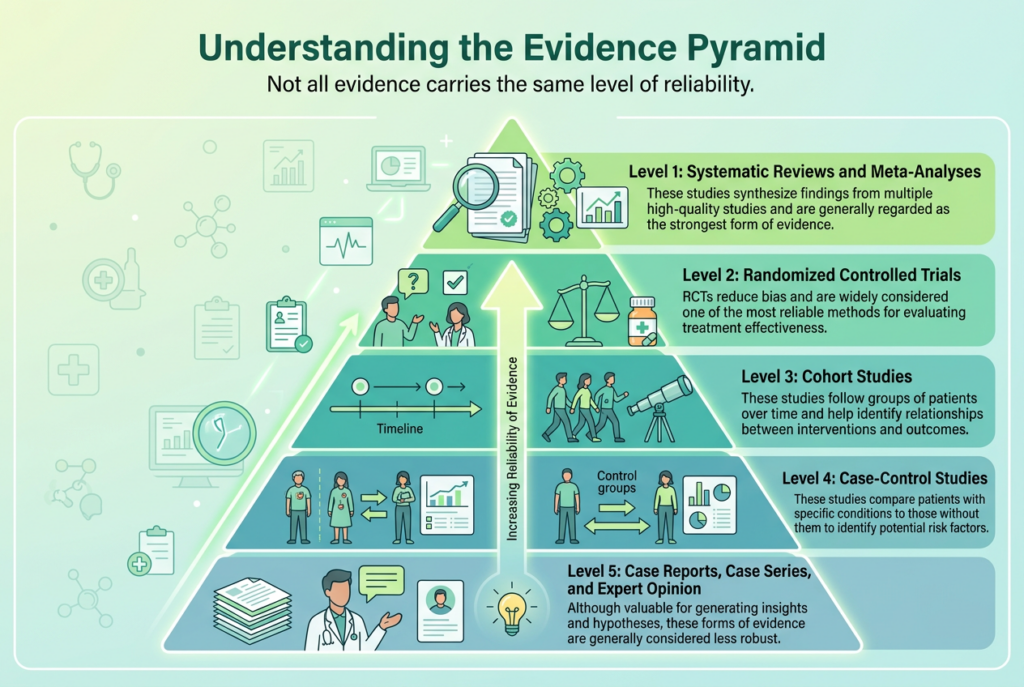
Understanding the Evidence Pyramid
Not all evidence carries the same level of reliability.
Level 1: Systematic Reviews and Meta-Analyses
These studies synthesize findings from multiple high-quality studies and are generally regarded as the strongest form of evidence.
Level 2: Randomized Controlled Trials
RCTs reduce bias and are widely considered one of the most reliable methods for evaluating treatment effectiveness.
Level 3: Cohort Studies
These studies follow groups of patients over time and help identify relationships between interventions and outcomes.
Level 4: Case-Control Studies
These studies compare patients with specific conditions to those without them to identify potential risk factors.
Level 5: Case Reports, Case Series, and Expert Opinion
Although valuable for generating insights and hypotheses, these forms of evidence are generally considered less robust.
Why Evidence-Based Medicine Improves Patient Care
Evidence-based medicine contributes directly to improved patient outcomes. Clinicians who use current evidence are better equipped to identify effective treatments, avoid unnecessary interventions, and reduce patient risk.
Furthermore, EBM promotes consistency in clinical practice. Patients benefit from decisions supported by scientific research rather than outdated habits or unsupported assumptions. As a result, healthcare becomes safer, more predictable, and more transparent.
The Challenge of Information Overload
Despite its benefits, evidence-based medicine presents a practical challenge. Medical literature continues to expand at a remarkable pace. New studies, reviews, and guidelines are published daily.
For busy clinicians, reviewing and critically appraising every relevant publication is unrealistic. Administrative responsibilities, patient documentation, and direct clinical care often leave limited time for literature review.
Consequently, the challenge is no longer locating information. Instead, the challenge is finding trustworthy, clinically relevant information quickly enough to use it during patient care.
How Dora Evidence Helps
Dora Evidence is the Clinical Decision Support platform within the DoraScribe ecosystem. It was designed to help healthcare professionals access evidence-based information efficiently and effectively.
Rather than searching across multiple journals, websites, databases, and guidelines, clinicians can use Dora Evidence to explore clinical questions, review supporting literature, evaluate treatment options, and access guideline-based recommendations.
By streamlining access to evidence, Dora Evidence helps reduce the time spent searching for information while supporting evidence-informed clinical decision-making.
Most importantly, Dora Evidence does not replace clinical expertise. The clinician remains responsible for interpreting evidence and determining what is appropriate for each patient.

The Future of Evidence-Based Healthcare
Healthcare continues to become more complex. Medical knowledge is expanding, patient expectations are evolving, and clinical decisions increasingly require access to current evidence.
Technology will play an important role in helping healthcare professionals navigate this complexity. Clinical Decision Support platforms help transform large volumes of medical information into practical knowledge that can be applied at the point of care.
The future is not about replacing clinicians with technology. Instead, it is about equipping clinicians with better tools that support better decisions.
Final Thoughts
Evidence-based medicine remains one of the most important advances in modern healthcare. By combining scientific evidence, clinical expertise, and patient preferences, healthcare professionals can deliver safer and more effective care.
At the same time, the rapid growth of medical knowledge has created new challenges. Dora Evidence was developed to help healthcare professionals access trusted evidence more efficiently, enabling them to spend less time searching and more time focusing on patient care.
Better access to evidence supports better decisions. Ultimately, better decisions contribute to better patient outcomes.
References
- Sackett DL, Rosenberg WM, Gray JA, Haynes RB, Richardson WS. Evidence based medicine: what it is and what it isn’t. BMJ. 1996;312(7023):71–72.
- Hariton E, Locascio JJ. Randomised controlled trials: the gold standard for effectiveness research. BJOG. 2018;125(13):1716.
- Bastian H, Glasziou P, Chalmers I. Seventy-five trials and eleven systematic reviews a day. PLoS Med. 2010;7(9):e1000326.