En el acelerado entorno sanitario actual, la información es abundante, pero a menudo inaccesible. El 80% de los datos sanitarios no están estructurados, sepultado entre notas clínicas de texto libre, informes de imágenes y resúmenes de alta. Esto dificulta el acceso, el análisis y la acción en base a información valiosa.
Pero la inteligencia artificial (IA) está cambiando esto rápidamente.
Al aprovechar la IA, los proveedores de atención médica pueden transformar datos desorganizados en formatos estructurados, buscables y procesables, lo que allana el camino para una toma de decisiones más inteligente y mejores resultados para los pacientes.
Este artículo explora el papel de la IA en la estructuración de datos médicos, sus aplicaciones en el mundo real y la beneficios transformadores Aporta a la práctica clínica.
Comprensión de datos médicos no estructurados
Los datos no estructurados incluyen cualquier información que no siga un formato predefinido. En el ámbito sanitario, esto suele significar
- Notas clínicas de texto libre
- Dictados de voz
- Informes de radiología y patología
- Documentos escaneados y PDF
Si bien son ricos en detalles, este tipo de datos no se puede interpretar fácilmente con software o herramientas analíticas tradicionales. Se convierte en un obstáculo para todo, desde el apoyo a la toma de decisiones clínicas hasta la gestión de la salud poblacional.
De acuerdo con Arcadia, aproximadamente el 47% de los datos están subutilizados en la toma de decisiones sanitarias, destacando los desafíos que plantean los datos no estructurados.
Por qué es importante estructurar los datos médicos
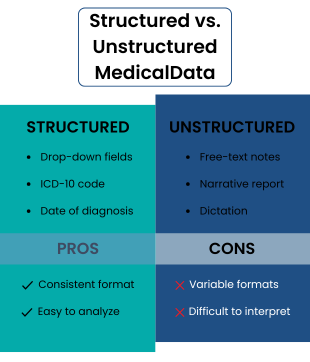
Los datos no estructurados no sólo son incómodos: también suponen un riesgo clínico.
Sin información estructurada, los profesionales sanitarios pueden:
- Pasar por alto detalles críticos en el historial de un paciente
- Encontrar retrasos en el diagnóstico y el tratamiento
- Lucha con documentación incompleta o inconsistente
Datos estructurados, por otro lado, permite:
- Recuperación de información más rápida
- Integración más sencilla con sistemas de apoyo a la toma de decisiones
- Informes de facturación y cumplimiento más precisos
Piense en ello como convertir un archivador desordenado en una base de datos optimizada y con capacidad de búsqueda.
Cómo la IA estructura los datos médicos
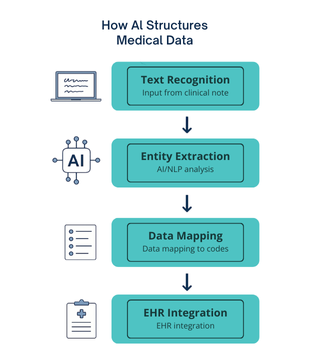
IA, específicamente Procesamiento del lenguaje natural (PNL) y aprendizaje automático (ML) herramientas diseñadas para comprender y estructurar el lenguaje humano.
Así es como funciona:
- Reconocimiento de texto— La IA lee notas clínicas y transcripciones de texto libre.
- Extracción de entidades— Identifica términos relevantes: medicamentos, síntomas, diagnósticos y procedimientos.
- Integración- Los datos estructurados se insertan automáticamente en los campos EHR correctos.
Herramientas modernas como Amazon Comprende MédicoMicrosoft Dragon Copilot, y marLP activo (anteriormente conocido como IBM Watson Health) puede extraer información significativa en segundos, ahorrando tiempo y reduciendo el error humano.
Beneficios clave de la estructuración de datos impulsada por IA
La IA no solo procesa datos, sino que transforma los flujos de trabajo. Estas son sus principales ventajas:
- Documentación más rápidaLos médicos pasan menos tiempo escribiendo y más tiempo con los pacientes.
- Carga administrativa reducida:Diga adiós a los gráficos fuera del horario laboral.
- Analítica mejorada:Los datos estructurados respaldan el conocimiento clínico y el modelado predictivo.
- Mejor diagnóstico y atención:El acceso al contexto completo del paciente mejora las decisiones clínicas.
- 🔐 Preparación regulatoria:Cumplimiento más sencillo de HIPAA y estándares de auditoría.
Un estudio publicado en Red de JAMA abierta Descubrieron que la documentación clínica impulsada por IA mejoraba la experiencia de los registros médicos electrónicos de los médicos, lo que sugiere una posible reducción del agotamiento.
Aplicaciones reales en la atención médica en América del Norte
En Estados Unidos y Canadá, los principales sistemas de atención médica ya están adoptando IA para la gestión de datos no estructurados.
- Departamentos de emergencia Utilice escribas de inteligencia artificial para capturar notas durante visitas de pacientes de gran volumen.
- Prácticas de atención primaria integrar PNL para generar estructurado SOAP notas.
- Plataformas de telesalud Incorporar IA para autoestructurar las transcripciones de visitas virtuales.
Por ejemplo, Mayo Clinic implementado Asistente de inteligencia artificialDocumentación de sted que reduce el tiempo de documentación del proveedor hasta en un 70%, permitiendo un mayor enfoque en la atención al paciente.
Abordando las preocupaciones: precisión, sesgo y privacidad
Como ocurre con cualquier tecnología, el uso responsable de la IA es fundamental. Entre las preocupaciones más comunes se incluyen:
- ExactitudLos modelos de IA deben entrenarse y validarse continuamente para evitar malas interpretaciones.
- ParcialidadLas herramientas deben probarse en diversas poblaciones para garantizar la equidad. Las investigaciones demuestran que Los modelos de IA pueden perpetuar las disparidades en la atención médica Si no se gestiona adecuadamente.
- Privacidad:Todas las herramientas de IA deben cumplir con los estándares HIPAA y proteger los datos de salud confidenciales, como iLa integración de la IA en la atención médica requiere actualizar las medidas de seguridad de HIPAA para abordar nuevos desafíos.Desafíos.
El futuro está estructurado de forma inteligente
La IA está revolucionando la gestión de datos médicos: no reemplazando a los profesionales clínicos, sino empoderándolos. La estructuración de datos revela información crucial, optimiza los flujos de trabajo y mejora los resultados de los pacientes.
A medida que crece la adopción de IA, la oportunidad de reducir el agotamiento, mejorar los diagnósticos y acelerar la innovación nunca ha sido mayor.
¿Listo para abrazar el futuro de la atención médica inteligente? Descubra cómo IA de Dorascribe puede ayudar a estructurar sus datos, una nota a la vez.