Dans le contexte actuel de soins de santé en constante évolution, l'information est abondante, mais souvent inaccessible. 80 % des données de santé ne sont pas structurées, enfouies dans des notes cliniques en texte libre, des rapports d'imagerie et des résumés de sortie. Cela rend difficile l'accès, l'analyse et l'exploitation d'informations précieuses.
Mais l’intelligence artificielle (IA) change rapidement cela.
En tirant parti de l’IA, les prestataires de soins de santé peuvent transformer des données désorganisées en formats structurés, consultables et exploitables, ouvrant ainsi la voie à une prise de décision plus intelligente et à de meilleurs résultats pour les patients.
Cet article explore le rôle de l'IA dans la structuration des données médicales, ses applications concrètes et les avantages transformateurs elle apporte à la pratique clinique.
Comprendre les données médicales non structurées
Les données non structurées incluent toute information qui ne respecte pas un format prédéfini. Dans le domaine de la santé, cela signifie généralement :
- Notes cliniques en texte libre
- Dictées vocales
- Rapports de radiologie et de pathologie
- Documents numérisés et PDF
Bien que riches en détails, ces données sont difficiles à interpréter par les logiciels ou outils d'analyse traditionnels. Elles constituent un obstacle à tout, de l'aide à la décision clinique à la gestion de la santé des populations.
Selon Arcadia, environ 47 % des données sont sous-utilisées dans la prise de décision en matière de soins de santé, soulignant les défis posés par les données non structurées.
Pourquoi la structuration des données médicales est importante
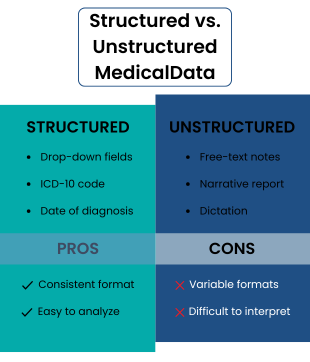
Les données non structurées ne sont pas seulement gênantes : elles constituent également un risque clinique.
Sans informations structurées, les professionnels de la santé peuvent :
- Omettre des détails critiques dans l'historique d'un patient
- Rencontrer des retards dans le diagnostic et le traitement
- Lutte contre une documentation incomplète ou incohérente
Données structurées, d'autre part, permet :
- Récupération d'informations plus rapide
- Intégration plus facile avec les systèmes d'aide à la décision
- Facturation et rapports de conformité plus précis
Considérez cela comme la transformation d’un classeur en désordre en une base de données simplifiée et consultable.
Comment l'IA structure les données médicales
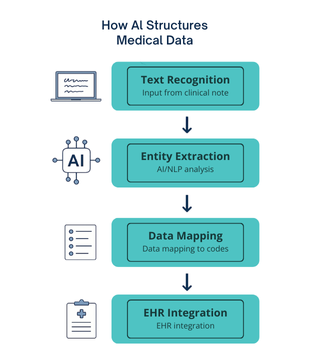
L'IA, en particulier Traitement du langage naturel (PNL) et apprentissage automatique (ML) outils conçus pour comprendre et structurer le langage humain.
Voici comment cela fonctionne:
- Reconnaissance de texte— L’IA lit les notes cliniques et les transcriptions en texte libre.
- Extraction d'entités — Il identifie les termes pertinents : médicaments, symptômes, diagnostics et procédures.
- Intégration- Les données structurées sont automatiquement insérées dans les champs EHR appropriés.
Des outils modernes comme Amazon Comprehend MedicalMicrosoft Dragon Copilot et MerLP actif (anciennement connu sous le nom d'IBM Watson Health) peut extraire des informations significatives en quelques secondes, ce qui permet de gagner du temps et de réduire les erreurs humaines.
Principaux avantages de la structuration des données alimentée par l'IA
L'IA ne se contente pas de nettoyer les données : elle transforme les flux de travail. Voici ses principaux avantages :
- Documentation plus rapide:Les cliniciens passent moins de temps à taper et plus de temps avec les patients.
- Réduction de la charge administrative:Dites adieu aux graphiques en dehors des heures de bureau.
- Analyses améliorées:Les données structurées soutiennent les connaissances cliniques et la modélisation prédictive.
- Un meilleur diagnostic et de meilleurs soins:L’accès au contexte complet du patient améliore les décisions cliniques.
- (I.e. Préparation réglementaire:Conformité plus facile avec les normes HIPAA et d'audit.
Une étude publiée dans Réseau JAMA ouvert Il a été constaté que la documentation clinique alimentée par l'IA améliorait l'expérience des cliniciens en matière de dossiers médicaux électroniques, ce qui suggère une réduction potentielle de l'épuisement professionnel.
Applications concrètes dans le secteur de la santé en Amérique du Nord
Aux États-Unis et au Canada, les principaux systèmes de santé adoptent déjà l’IA pour la gestion des données non structurées.
- Urgences utiliser des scribes IA pour capturer des notes lors de visites de patients à volume élevé.
- cabinets de soins primaires intégrer PNL les outils générer des structures SOAP Remarques.
- Plateformes de télésanté intégrer l'IA pour auto-structurer les transcriptions des visites virtuelles.
Par exemple, Mayo Clinic mis en œuvre AI-assidocumentation sted qui réduit le temps de documentation du fournisseur jusqu'à 70 %, permettant de se concentrer davantage sur les soins aux patients.
Répondre aux préoccupations : exactitude, partialité et confidentialité
Comme pour toute technologie, une utilisation responsable de l'IA est essentielle. Parmi les préoccupations courantes, on peut citer :
- Exactitude:Les modèles d’IA doivent être continuellement formés et validés pour éviter toute mauvaise interprétation.
- Préjugé:Les outils devraient être testés auprès de populations diverses pour garantir l'équité. Les recherches montrent que Les modèles d’IA peuvent perpétuer les disparités en matière de soins de santé si elle n'est pas correctement gérée.
- Politique de confidentialité :Tous les outils d'IA doivent respecter les normes HIPAA et protéger les données de santé sensibles, comme iL'intégration de l'IA dans les soins de santé nécessite la mise à jour des mesures de sécurité HIPAA pour répondre aux nouvelles exigences.défis.
L'avenir est intelligemment structuré
L'IA révolutionne notre façon de traiter les données médicales, non pas en remplaçant les cliniciens, mais en leur donnant les moyens d'agir. La structuration des données permet d'obtenir des informations cruciales, de rationaliser les flux de travail et d'améliorer les résultats pour les patients.
À mesure que l’adoption de l’IA se développe, l’opportunité de réduire l’épuisement professionnel, d’améliorer les diagnostics et d’accélérer l’innovation n’a jamais été aussi grande.
Prêt à adopter l'avenir des soins de santé intelligents ? Découvrez comment Dorascribe IA peut vous aider à structurer vos données, une note à la fois.