If you spend even a day around surgeons, whether in orthopedics, urology, cardiovascular surgery, general surgery, or pediatrics, one thing becomes very clear very quickly: they did not choose this field to sit behind a computer.
They chose it because they like fixing things and working with their hands. To operate. To see a problem and solve it pragmatically.
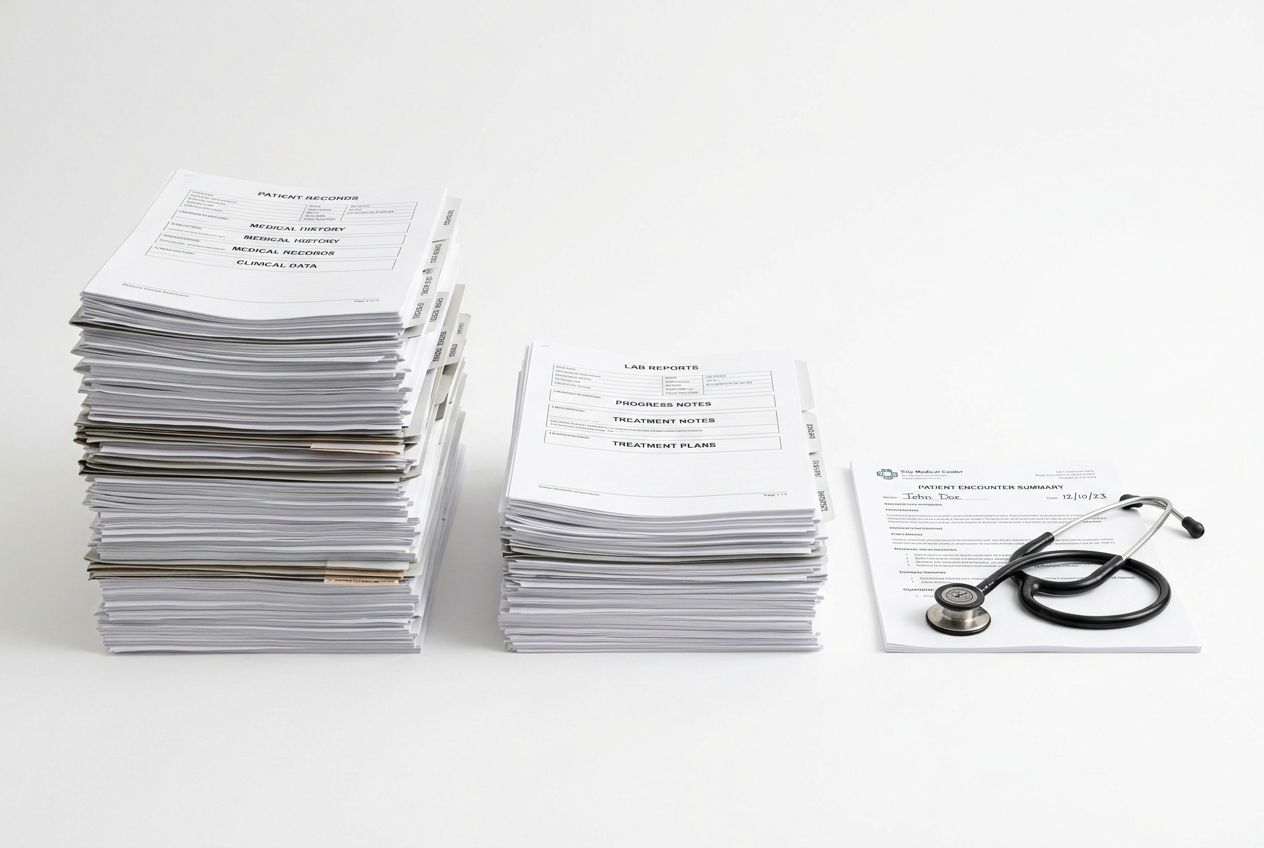
And yet, a huge portion of their day is spent doing the opposite of what they strive to do. Typing. Charting. Trying to remember what happened three patients ago so they can document it properly. If they do not, or if the paperwork is erroneous, it is not just inconvenient. It is a liability.
Let’s take the strain off those who are most needed for their esoteric knowledge and decisiveness. Let us take care of the paperwork.

When Documentation Becomes Legal Risk
The Hippocratic Oath emphasizes non-maleficence, or “doing no harm.” But in today’s medico-legal landscape, incomplete documentation can become harm of its own.
Documentation is not just administrative. It is legal protection.
Every note becomes part of a permanent record that can be reviewed months or years later in the context of a complaint or lawsuit. And when that happens, what matters is not just what the surgeon did. It is what they documented. It is what proof they have to show what occurred behind closed doors.
Whether in cardiovascular surgery, urology, general surgery, or pediatric care, surgeons are required to maintain detailed records of operative decisions, informed consent, and post-operative management. Failures in these areas, particularly incomplete notes, delayed documentation, or unclear communication, are repeatedly identified as contributing factors in medico-legal cases. In this sense, the challenge is not unique to one specialty.
Research consistently shows that incomplete or inconsistent medical records are a major factor in malpractice claims. Medical documentation issues contribute to 10 to 20 percent of medical malpractice lawsuits. Inaccurate, incomplete, or generic records undermine a physician’s defence and make a plaintiff’s lawyer more likely to take on a case.
Furthermore, in high-risk surgical fields, long-term data suggest that the majority of surgeons will face at least one medico-legal claim over the course of their careers, with a cumulative rate of at least one lawsuit over a 30-year period exceeding 90 percent.
This is why it is quintessential to take control of your documenting practices.

Orthopedic Surgeons Face Elevated Risk
For orthopedic surgeons, the risk is even higher:
- Over a 5-year period:
- 27 percent were named in 1 medico-legal case
- 17.5 percent were named in 2 to 4 cases
- Annually:
- 13.2 percent face at least one new case
Documentation is reflective, slow, and detail-heavy. So it often gets pushed to the end of the day or done quickly between patients. That is where problems start.
What the Data Says About Medical AI Scribes
A recent systematic review found that AI scribes show promising evidence regarding improvements in documentation efficiency and clinician workflow. The review analyzed eight studies conducted across the United States, Bangladesh, and the Netherlands between 2021 and 2024.
Eight studies were included, and these were the results:
- AI scribes demonstrated positive effects on healthcare provider engagement, with users reporting increased involvement in their workflows.
- The documentation burden showed signs of improvement as AI scribes helped alleviate participants’ workload.
- There was a statistically significant increase in productivity and in the number of notes completed per day.
- Documentation time per patient decreased from 5.3 minutes to 4.54 minutes.
- There was a decrease in the 24-hour documentation deficiency rate, from 8.6 percent incomplete before AI scribes to 6.3 percent incomplete after using AI scribes.
This systematic review and experimentation in eight differing cases show how beneficial AI scribes can be.
The Most Common Documentation Failures for Surgeons
Here are some of the most common documentation failures in lawsuits involving surgeons:
- Missing documentation (70 percent)
- Inadequate post-operative notes
- Delayed documentation
- Inaccurate or illegible records
- Failed informed consent
- Failure to document non-compliant patients
If it is not documented, the legal system treats it as if it did not happen. As noted in the systematic review above, these gaps were addressed and alleviated with the use of AI scribes.
Let Surgeons Be Surgeons with Dorascribe
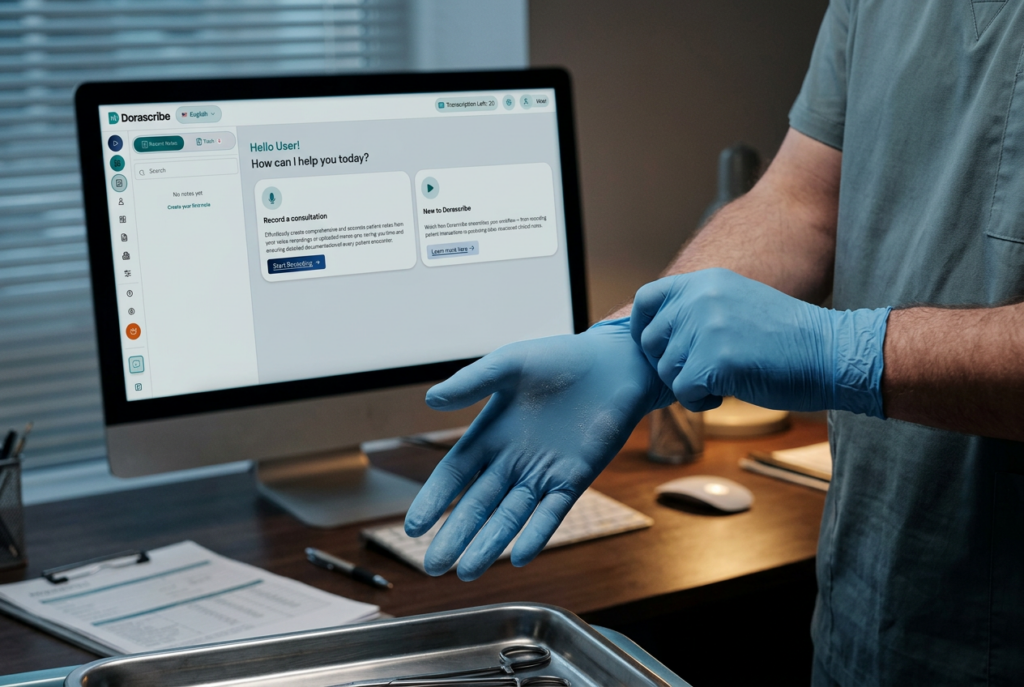
This is where tools like Dorascribe come in, but not in the way people usually think about AI platforms.
Instead of asking surgeons to stop, type, and document, it works in the background, capturing clinical conversations and structuring them into clear, usable medical notes.
So instead of thinking, “I need to remember to chart this later,” the documentation is already there and complete.
Why This Matters More Than Just Convenience
At first glance, this sounds like a time-saving tool. And it is. But the deeper value is in consistency and protection.
When documentation is created in real time, rather than hours later, it is:
- More accurate
- More complete
- More consistent
- Easier to defend
In medico-legal contexts, clear and contemporaneous records are one of the strongest forms of protection. Not because they guarantee outcomes, but because they demonstrate clarity, reasoning, and continuity of care.
Reclaiming Your Time
One of the biggest concerns around AI in healthcare is loss of control.
But Dorascribe does not remove the surgeon from the process. It simply removes the most tedious part.
The surgeon still:
- Makes every clinical decision
- Reviews documentation
- Maintains full responsibility for care

The Bigger Shift
What is happening here is not just about technology or AI. It is about realigning medicine with how clinicians actually work.
Surgeons are at their best when they are:
- Focused
- Decisive
- Present with their patients
Not when they are trying to remember how to phrase a note at the end of a 10-hour day.
Tools like Dorascribe do not change what surgeons do. They just remove the added paperwork that surrounds it.
Ultimately, surgeons did not choose their field to write notes. But in modern healthcare, documentation is unavoidable and increasingly tied to legal risk. Dorascribe changes that dynamic by making documentation automatic, accurate, and aligned with real clinical workflows.
Join hundreds of healthcare professionals who use Dorascribe and begin reclaiming your time.
References
- Ghaith S, Moore GP, Colbenson KM, Lindor RA. Charting Practices to Protect Against Malpractice: Case Reviews and Learning Points. West J Emerg Med. 2022;23(3):412–417.
- Canadian Medical Protective Association. Medico-Legal Risk: What Orthopedic Surgeons Need to Know. Ottawa (ON): CMPA; 2024.
- Sasseville M, Yousefi F, Ouellet S, Naye F, Stefan T, Carnovale V, et al. The Impact of AI Scribes on Streamlining Clinical Documentation: A Systematic Review. Healthcare (Basel). 2025;13(12):1447.
- McGrory BJ, Schurman DJ, Freiberg AA. Surgeon Demographics and Medical Malpractice in Adult Reconstruction. Clin Orthop Relat Res. 2009;467(2):358–366.