The growing demand for faster, more accurate medical documentation has led many clinicians to explore the advantages of using an AI medical scribe. While the benefits are clear—reduced charting time, improved accuracy, and better patient focus—doctors often have important questions before making the switch.
This guide answers the most common questions physicians ask when evaluating an AI medical scribe and includes links to detailed resources across the Dorascribe blog.
1. How accurate is an AI medical scribe compared to manual charting?
Dorascribe’s transcription and note-generation models are trained on clinically validated datasets, enabling them to capture terminology, abbreviations, and physician-specific phrasing with high accuracy. Unlike manual typing—where fatigue and time pressure can introduce inconsistencies—Dorascribe produces consistent, structured notes even during fast-paced encounters. Accuracy improves further as the system adapts to a clinician’s voice and style over time.
For details on real-time performance and accuracy benchmarks, read:
Real-Time AI Medical Scribe in 2025: Faster Notes, Zero Delay

2. Will an AI scribe save me time every day?
Most physicians report saving 1–2 hours per day, with some saving even more depending on visit complexity. Dorascribe automates the entire documentation workflow—from listening in the background to generating a structured note—reducing the need for after-hours charting. This allows doctors to either see more patients or reclaim personal time, significantly decreasing burnout.
For specialty-specific examples, explore:
Benefits of AI Documentation in Family Medicine
3. Is it secure and HIPAA compliant?
Security and privacy remain top concerns for clinicians adopting digital tools. Dorascribe uses end-to-end encryption, secure cloud infrastructure, and strict PHIPA/HIPAA-aligned protocols. No unapproved third-party services or data pipelines are used. All audio and note data are processed securely, ensuring compliance with U.S., Canadian, and international privacy requirements.
More details here:
Ensuring Patient Privacy and Data Security

4. Can the AI understand different accents, languages, or multilingual conversations?
Yes. Dorascribe is built for linguistic diversity. It performs reliably with a wide range of regional accents, rapid dialogue, and mixed-language encounters—an important advantage for clinics in multicultural areas. It supports French, Spanish, and multiple English dialects, making it suitable for Quebec, Latin America, and diverse U.S. patient populations.
Learn more:
Multilingual Medical Transcription & Global Documentation
5. How does an AI medical scribe integrate with my current workflow?
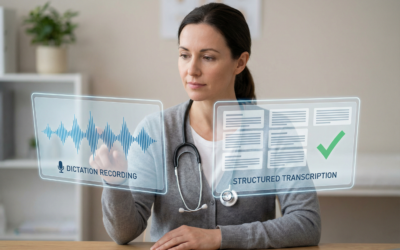
Dorascribe works alongside existing clinical workflows without requiring changes to your EHR or charting processes. Most clinicians begin using it within minutes. Notes can be copied directly into any EHR or exported as a PDF for record-keeping or compliance. Dorascribe also supports copying plain-text versions, allowing clinicians to transfer notes seamlessly into their systems.

6. What types of notes can the AI generate?
Dorascribe produces fully structured and specialty-specific notes, including SOAP notes, referrals, follow-up summaries, histories, progress notes, and detailed documentation for psychiatry, physiotherapy, chiropractic care, and emergency medicine. Notes can be adjusted to be concise or highly detailed depending on clinic preference.
7. Does it work for telehealth visits?
Yes. Dorascribe excels in virtual care environments. Whether on video or audio-only consultations, the system captures dialogue accurately and structures it into a clean, shareable clinical note. Telehealth providers often find AI-powered documentation even more valuable during remote care, where multitasking is common.
Learn more about telehealth workflows:
AI Medical Scribes for Telehealth
8. How much control do I have over the final note?
Dorascribe ensures that doctors remain fully in control. You can edit, adjust tone, expand or shorten sections, and regenerate any part of the note instantly. The goal is not just automation but better clinician oversight—letting you finalize documentation in a fraction of the time it normally takes.

9. How does using an AI scribe affect patient interactions?
Physicians consistently report improved patient engagement because they’re no longer tied to keyboards or looking back and forth between screens. With documentation handled in the background, clinicians maintain full eye contact and can be more present—improving trust, communication, and care quality.
Real-world impact explained:
The Silent Struggle of Physicians — and How AI Helps
10. What happens if the AI misses something or if the visit is complex?
While Dorascribe is trained to handle complex, multi-symptom encounters, physicians always have final review authority. Any note can be rewritten, expanded, or re-summarized, ensuring full clinical accuracy. The system’s flexibility makes it reliable for both straightforward follow-ups and in-depth diagnostic visits.
Complex-case workflows covered here:
AI vs Manual Documentation: What Doctors Should Know

Additional Resources
- Explore more specialties: AI Tools for Physiotherapists
- See how notes are structured: Chiropractor AI Scribing
- Understand real‑world primary care workflows: AI Scribing in Primary Care
Browse all help articles and get answers fast:
Dorascribe FAQ
Ready to Try Dorascribe?
If you’re evaluating whether an AI medical scribe is right for your clinic, the best way to understand the workflow is to test it yourself. Dorascribe offers a seamless onboarding experience with no setup complexity.
Start your free trial or sign up now
This post is optimized for the primary keyword AI medical scribe, and secondary keywords related to workflow, accuracy, security, and physician adoption.