
Quick answer: A pediatric AI scribe workflow must recognize that the child or adolescent is the patient even when a parent does most of the speaking. Clinics should define who may authorize ambient documentation, how assent or dissent is handled, when confidential conversation requires a different workflow, how speakers are attributed, and how the pediatric clinician reviews the draft before it becomes part of the chart.
Pediatric encounters are rarely a simple conversation between one clinician and one patient. A parent may describe the history, a child may correct it, a sibling may interrupt, an interpreter may relay information, and an adolescent may need time alone with the clinician. An ambient documentation system must preserve those distinctions instead of flattening every voice into one authoritative narrative.
This makes pediatrics a valuable but demanding use case for AI medical scribes. The technology may reduce manual drafting, but it does not determine capacity, identify the lawful decision-maker, decide what should remain confidential, or establish whether a statement is clinically reliable. Those responsibilities remain with the clinic and the responsible healthcare professional.
Why an adult documentation workflow is not enough
The balance among patient participation, parental authority, substitute decision-making, and confidentiality changes with age, development, capacity, the service being provided, and applicable law. The Canadian Paediatric Society emphasizes that participation should increase with a child’s developing capacity and that consent rules are jurisdiction-specific. In the United States, HHS similarly notes that a parent is usually a minor’s personal representative under HIPAA, while recognizing important exceptions governed by state or other law.
A clinic therefore needs more than a generic consent sentence. It needs an approved process that tells staff what to explain, whose decision is required, what to do when a young patient objects, and when to pause ambient documentation for a private or sensitive discussion. DoraScribe’s AI scribe consent guide can support planning, but it cannot replace jurisdiction-specific clinical, privacy, or legal review.

Design the workflow around the pediatric patient
Identify the patient, encounter, and participating adults
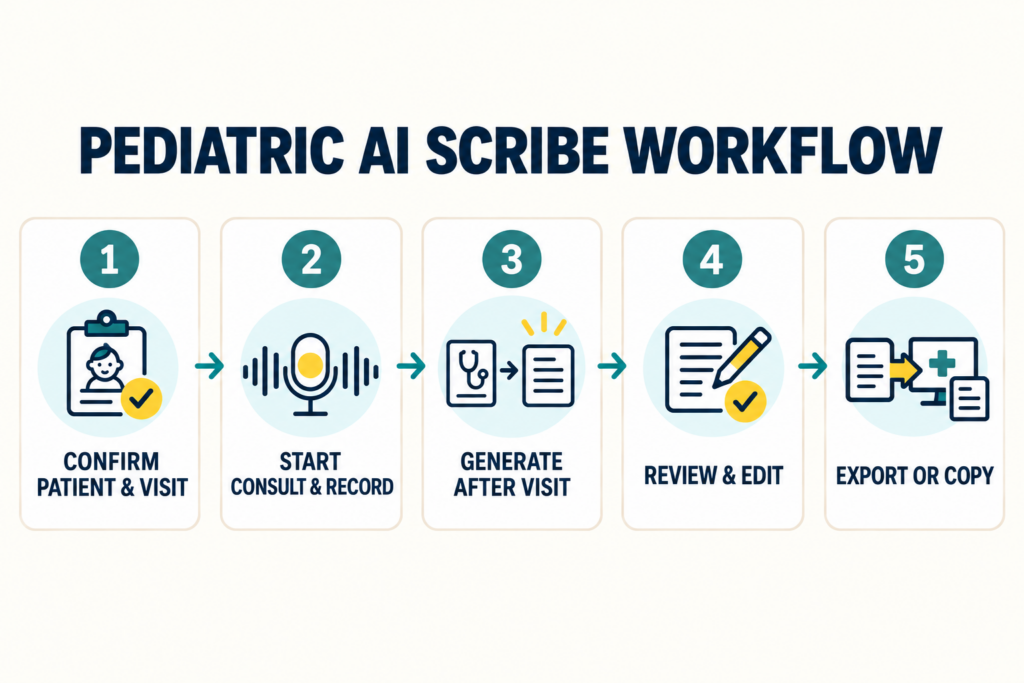
Before capture begins, verify the child or adolescent, the current encounter, the responsible clinician, and the adults participating in the visit. Do not infer legal authority from who brought the child to the clinic. Where relevant, the clinic’s existing registration and consent process should establish the relationship and decision-making authority rather than asking the scribe to determine it from conversation.
Patient matching requires particular care when siblings attend together, twins have similar identifiers, or a parent raises concerns about more than one child. The capture session should have one explicit patient context. If the conversation shifts to another child, staff need a clear way to stop and begin a separate governed encounter rather than allowing information to cross charts.
Explain ambient documentation in age-appropriate language
Patient communication should fit the developmental stage. A young child may need a simple explanation of what the clinician is doing, while an adolescent may need a direct discussion of privacy, who can access the note, and whether the technology remains active during time alone. Even when a child cannot provide legal consent, seeking age-appropriate participation can support trust and reveal discomfort that the team should address.
The clinic should decide how assent, dissent, and questions are handled within its policies. A visible objection should not be treated as background noise. Staff should know whether to stop ambient capture, document by another method, or seek help from the responsible clinician, privacy office, or other designated owner.
Protect confidential adolescent care
Confidential care is an important part of adolescent health. The Canadian Paediatric Society describes time alone with a healthcare provider and protection of health information as core considerations, while also emphasizing applicable consent and disclosure rules. A pediatric scribe workflow should make it easy to pause or end capture before a confidential conversation and should not automatically expose sensitive content to an accompanying adult or a shared patient-facing summary.
The clinic should test transitions: parent present to parent absent, ambient capture active to paused, and general history to a sensitive topic. Define what happens to the earlier transcript or draft, who can see it, and how the clinician documents confidential information in the appropriate record area. Privacy design should complement the broader guidance on patient privacy and data security.
Test differently across developmental stages
Infants and toddlers
For infants and toddlers, much of the history comes from a caregiver while the clinician contributes observations and examination findings. Test whether the draft clearly attributes caregiver-reported symptoms and avoids implying that the child supplied a detailed history. Visits may also include feeding, sleep, development, growth, safety, and family context; templates should include only what was actually addressed.
School-aged children
School-aged children may answer directly while a caregiver adds context or offers a different account. The draft should preserve meaningful disagreement and indicate the source rather than blending both versions. Evaluate how the system handles a child speaking softly, using age-specific language, moving around the room, or responding nonverbally while the caregiver interprets the behaviour.
Adolescents
Adolescent visits require particular attention to autonomy, confidential care, sensitive topics, and portal access. Test how the workflow changes when a parent leaves the room, when the adolescent supplies information that differs from the caregiver’s account, and when part of the note needs restricted handling under the clinic’s systems and applicable rules. The technology should support the clinician’s privacy process rather than dictate it.
Make multi-speaker attribution explicit
A clinically useful pediatric note distinguishes among patient-reported symptoms, caregiver observations, clinician findings, interpreter-relayed statements, and information imported from the chart. Those sources are not interchangeable. A parent saying that a child had a fever, a child denying pain, and a clinician observing normal movement are three different kinds of information and should not be merged into a single unsupported statement.
During evaluation, use realistic multi-speaker cases. Include a quiet child, a talkative caregiver, contradictory accounts, a sibling interruption, an interpreter-supported visit where permitted, and a caregiver speaking a different language from the patient. DoraScribe’s article on multilingual AI scribing provides additional context for multilingual workflows, but pediatric testing should focus specifically on speaker and source attribution.
Adapt templates to age, visit type, and specialty
A pediatric template should not be an adult template with different vital signs. Newborn visits, well-child care, acute illness, developmental concerns, mental health, medication follow-up, and procedures may require different structure and different sensitivity to who supplied the history. The clinic should decide which sections are required, which are optional, and which should never be populated merely because the template contains them.
Start by reviewing the clinic’s existing doctor’s note templates and the available approach to custom AI scribe templates. Keep growth, immunization, developmental, and safeguarding content under the clinic’s governed workflow. The generated draft should not invent a normal finding, infer a milestone, or convert an incomplete discussion into a completed assessment.
Build clinician review around predictable pediatric risks
Before finalization, the clinician should confirm patient and encounter identity, the source of material statements, age and developmental context, allergies and medications, examination findings, assessment, plan, follow-up, and any instructions given to the family. Review contradictions between the child and caregiver rather than silently choosing one account. Remove irrelevant conversation and information about another family member.
Human review is not a ceremonial final click. It is the point at which clinical meaning, uncertainty, and appropriateness are established. The broader article on why doctors are not being replaced helps explain why efficient drafting and professional judgment are complementary rather than competing roles.

Run a pediatric pilot before broad release
Pilot with a defined clinician group and representative visit types. Include infants, school-aged children, and adolescents; one- and two-caregiver visits; time alone with an adolescent; different note templates; and sessions in which ambient capture must be declined or stopped. Do not use real patient encounters for testing unless the clinic’s approved process, agreements, and safeguards permit it.
Include a scenario in which a caregiver discusses their own health or another family member. The draft should retain only information relevant and appropriate to the pediatric patient’s record. Teams should confirm how unrelated family information is removed, whether it belongs in a separate chart, and who resolves uncertainty before the note is signed.
Track wrong-patient or cross-sibling content, speaker-attribution corrections, missing material information, unsupported normal findings, sensitive-content handling, clinician editing time, and abandoned sessions. Review every early draft and investigate recurring corrections by template, visit type, and age group. A pediatric rollout should expand only when the clinic can explain how exceptions are handled, not merely when the average draft looks fluent.
Connect the workflow without bypassing review
If the clinic sends context to the scribe or returns documentation to the chart, review DoraScribe’s EHR and EMR integration options. The integration should preserve the pediatric patient context, draft status, clinician review, access controls, and the clinic’s correction process. It should not make confidential or uncertain content easier to distribute accidentally.
Clinic leaders can book a pediatric workflow demonstration using representative multi-speaker visits, template requirements, consent scenarios, and confidential-care transitions rather than a single adult-style sample encounter.
Sources and further reading
Canadian Paediatric Society: Medical Decision-Making in Paediatrics. Professional guidance on capacity, informed consent, substitute decision-makers, assent, dissent, and developmentally appropriate participation in care.
Canadian Paediatric Society: Privacy and Confidentiality in Adolescent Health Care. Professional guidance on confidential adolescent care, time alone, privacy of health information, and informed consent for services.
HHS: Personal Representatives Under the HIPAA Privacy Rule. Official U.S. guidance explaining when parents or others act as personal representatives and when applicable law creates exceptions.
ASTP/ONC: 2025 SAFER Guides. Official safety self-assessment resources covering patient identification, organizational responsibility, system management, and contingency planning.