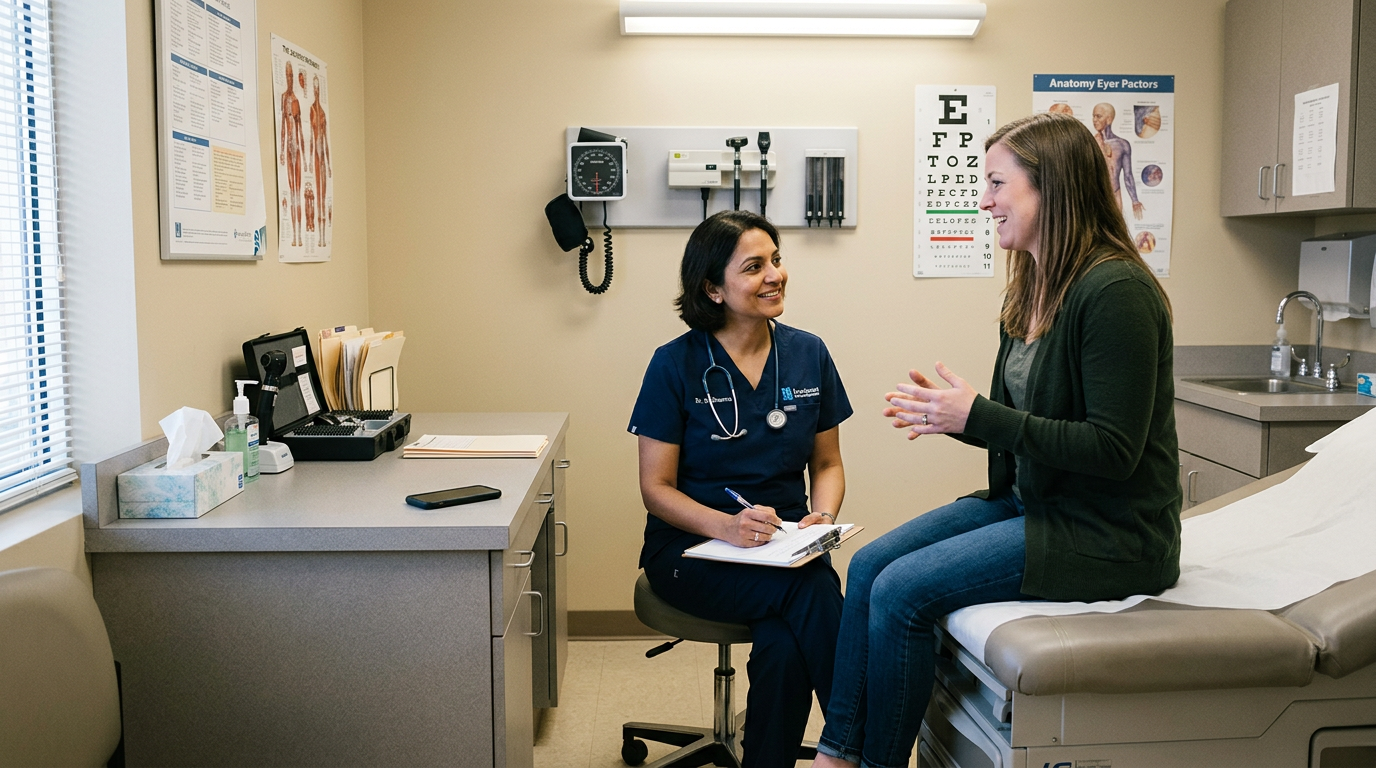
Consider a hypothetical heart failure follow-up. The patient describes increasing breathlessness, a relative adds details about medication use, and the chart contains an older echocardiogram alongside a recent discharge summary. The note must make clear what has changed, which information is current and what the cardiologist has decided.
AI scribes in cardiology can help turn the consultation into a structured draft. Their usefulness depends on how well that draft preserves clinical meaning and fits the work of reviewing investigations, reconciling medications and planning follow-up. The cardiologist remains responsible for the final record.
Bring the longitudinal record into the consultation note
Cardiology documentation often connects today’s symptoms with information gathered over months or years. A conversation may refer to a previous intervention, a changing ejection fraction or a medication adjustment made elsewhere. A scribe working only from audio needs that information to be supplied explicitly; access to the electronic record depends on the particular system and its configuration.
A 2026 simulation study involving 16 specialists, including four cardiologists, highlighted this issue. Cardiology participants emphasised the importance of incorporating previous investigations and chart information. The study tested two tools in simulated encounters over three days. Its small sample and non-significant differences between specialties do not establish how well AI scribes perform across cardiology practice.[1]
The practical implication is to define how background information enters the note. Identify its source and date, distinguish historical findings from current observations, and make unresolved discrepancies visible. More imported material is useful only when it helps explain the present assessment.

Match the note to the cardiology encounter
A focused template can make the draft easier to use. The following examples suggest information to preserve when it was discussed, observed or verified. They should be adapted to the consultation rather than populated with default findings.
| Encounter | Information to preserve |
|---|---|
| Heart failure follow-up | Change in symptoms and functional capacity; measured weight and blood pressure when available; relevant dated investigations; medication changes actually agreed upon; monitoring and follow-up responsibilities. |
| Atrial fibrillation or palpitations | Symptom pattern and timing; the source of any documented rhythm; relevant investigation results; treatment options discussed; the clinician’s anticoagulation decision and reasoning, if addressed. |
| Review after myocardial infarction or coronary intervention | Admission and procedure dates; source of procedural information; recovery and current symptoms; the confirmed medication plan, including any documented antiplatelet duration; responsibility for follow-up. |
| Valvular disease surveillance | Interval symptoms and activity changes; date and source of imaging findings; the cardiologist’s assessment of significance; investigations, surveillance or referral arrangements actually agreed upon. |
| Device clinic follow-up | Device and interrogation details from a verified source; symptoms and relevant findings; programming or treatment changes actually performed; the next review and any outstanding actions. |
Keep the assessment and plan easy to find. A long history should not obscure the reason for a medication change or the person responsible for arranging the next investigation. If no follow-up interval was specified, the software should not invent one.
Preserve the source of imaging findings
Ambient documentation captures spoken information. Echocardiographic measurements, electrocardiogram interpretation and device analysis require their own validated workflows and clinical oversight. An AI scribe’s ability to transcribe a finding does not establish that it can derive or independently verify that finding.
The American Society of Echocardiography’s 2025 reporting guideline emphasises standardised measurements and terminology, comparison with previous studies, and clear communication of results. Its discussion of AI-assisted reporting also recognises the need for validation and interpreting physician oversight.[2]
When an imaging result informs a consultation note, preserve the study date and whether the clinician reviewed the images, the report or both. Retain the distinction between a preliminary finding and a final interpretation. A previous ejection fraction should not silently become today’s measurement, and a comparison should not imply that images were reviewed when only a report was available.[2]

Keep medication decisions explicit
Medication documentation should distinguish what was prescribed previously, what the patient reports taking and what the cardiologist now recommends. Those three accounts may differ.
For example, in a hypothetical consultation, a patient reports stopping a medicine because of dizziness. The note should preserve that history and separately record the clinician’s response. It should not convert the patient’s decision into a clinician instruction or imply that a discontinued medicine remains active.
Where a medication is started, changed or stopped, verify the details actually established during the encounter. This includes the drug name and any specified dose, route, frequency, duration and monitoring plan. An unclear instruction such as “continue the blood thinner” requires clarification against a reliable source. A plausible drug or dose is not an acceptable substitute for missing information.
Similarly, document shared decisions and consent discussions as they occurred. A template cannot establish that a particular risk, alternative or procedure was discussed merely by inserting standard text.
Interpret time savings in the context of cardiology practice
The broader evidence supports evaluating AI scribes, with realistic expectations. A systematic review published online in December 2025 and assigned to a 2026 volume included 23 studies of AI documentation tools. It found promising reductions in documentation burden, but all included studies were non-randomised, methods were generally weak and results varied substantially.[3]
A randomised trial of 238 outpatient physicians across 14 specialties compared two ambient scribes with usual care for approximately two months. Only one platform significantly reduced measured note-writing time. Survey findings suggested possible wellbeing benefits, but these were secondary outcomes. The single-centre study used English-language encounters, and its electronic record measurements excluded editing time within the scribe applications.[4]
In a 2026 observational study of 8,581 clinicians across five US academic health systems, adoption was associated with 16 fewer documentation minutes per eight scheduled patient hours. Work outside scheduled hours did not decline significantly. The study was not randomised and did not establish a cardiology-specific effect.[5]
These findings cannot be converted into a promised saving for an individual cardiologist or attributed to a product that was not evaluated. They also do not demonstrate reductions in malpractice claims. The relevant question for a service is whether the complete documentation task becomes easier while the final record remains clinically reliable.

Evaluate the workflow during real cardiology clinics
Begin with a defined group of encounters, such as new outpatient consultations or heart failure reviews. Compare similar sessions before and during a pilot, allowing for the learning period.
Measure total documentation time, including preparation, editing within the scribe, chart completion and transfer into the patient record. Alongside time, track corrections that change clinical meaning, missing investigation dates, medication discrepancies and whether the plan is easy to find. Test consultations involving relatives or interpreters when these reflect your patient population.
Make consent and information handling part of implementation. Canadian Medical Protective Association guidance advises obtaining consent before recording, explaining relevant risks and reviewing the generated record. Services elsewhere should follow their own professional, legal and institutional requirements.[6] Confirm where recordings and transcripts are processed, who can access them, retention arrangements and any proposed secondary uses.
Keep a workable documentation process available if recording fails or a patient declines. Confirm how the completed note reaches the correct patient record and which actions still require the clinician or administrative team.
Dorascribe offers AI-assisted note generation and custom note templates, with template availability depending on the plan. Cardiologists can assess these features against their own consultation structure, particularly whether the resulting note keeps symptoms, dated investigations and the agreed plan easy to follow. Any required integration should be confirmed for the specific clinical environment.
A useful cardiology note helps the next clinician understand what changed and what needs to happen next. That is a practical standard against which to judge an AI scribe.
To explore AI-assisted documentation for your consultations, try our Community Edition.
References
1. Brunner J, Morrissey S, Stevens EM, Payne C, Wiltz S, Cutrona SL, et al. Ambient scribe technology in simulated patient encounters across specialties. JAMA Netw Open. 2026;9(1):e2552870. doi:10.1001/jamanetworkopen.2025.52870. https://doi.org/10.1001/jamanetworkopen.2025.52870
2. Taub CC, Stainback RF, Abraham T, Forsha D, Garcia-Sayan E, Hill JC, et al. Guidelines for the standardization of adult echocardiography reporting: recommendations from the American Society of Echocardiography. J Am Soc Echocardiogr. 2025;38(9):735-774. doi:10.1016/j.echo.2025.06.001. https://doi.org/10.1016/j.echo.2025.06.001
3. Zhao J, Liu H, Chen Y, Song F. Application of artificial intelligence tools and clinical documentation burden: a systematic review and meta-analysis. BMC Med Inform Decis Mak. 2026;26:29. doi:10.1186/s12911-025-03324-w. https://doi.org/10.1186/s12911-025-03324-w
4. Lukac PJ, Turner W, Vangala S, Chin AT, Khalili J, Shih YT, et al. Ambient AI scribes in clinical practice: a randomized trial. NEJM AI. 2025;2(12). doi:10.1056/AIoa2501000. https://doi.org/10.1056/AIoa2501000
5. Rotenstein LS, Holmgren AJ, Thombley R, Sriram A, Dbouk RH, Jost M, et al. Changes in clinician time expenditure and visit quantity with adoption of artificial intelligence-powered scribes: a multisite study. JAMA. 2026;335(16):1408-1417. doi:10.1001/jama.2026.2253. https://doi.org/10.1001/jama.2026.2253
6. Canadian Medical Protective Association. AI scribes: answers to frequently asked questions [Internet]. CMPA; 2023 Dec [updated 2025 Dec; cited 2026 Nov 16]. Available from: https://www.cmpa-acpm.ca/en/advice-publications/browse-articles/2023/ai-scribes-answers-to-frequently-asked-questions