An AI medical scribe is software that uses artificial intelligence to turn a clinical conversation into a structured draft note. It can capture an encounter, process the spoken information, and organize relevant details into a format such as a SOAP note. The clinician reviews, corrects, and approves the draft before it becomes part of the medical record.
For someone asking, “What is an AI medical scribe?”, the key distinction is between a transcript and a clinical note. A transcript follows the conversation. A scribe prepares documentation from that conversation, with the clinician responsible for checking what it includes and what it leaves out.
The College of Physicians and Surgeons of Ontario’s guidance on AI in clinical practice describes AI scribes as tools that capture and summarize encounters for physician review. It also distinguishes them from software that simply converts voice into text.
In this article
- How does an AI medical scribe work?
- What does “ambient” mean?
- AI scribes, dictation, transcription, and human scribes
- What can an AI medical scribe produce?
- What are the potential benefits?
- What are the limitations?
- Privacy and patient consent
- Who might use an AI medical scribe?
- What should a clinic evaluate?
- How Dorascribe fits the workflow
- Frequently asked questions
How does an AI medical scribe work?
Most AI scribe workflows connect three tasks: capturing information, drafting documentation, and checking the result. The precise technology and timing vary between products.
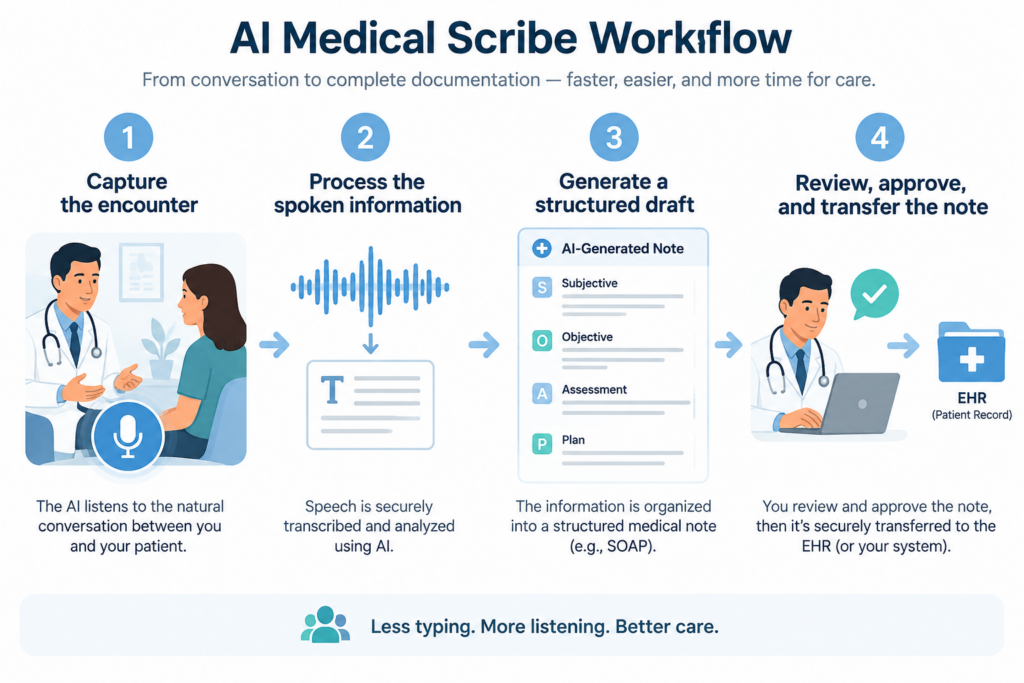
1. Capture the encounter
The clinician starts an approved capture session for the correct patient and visit. Depending on the service, the input may be a live conversation, clinician dictation, or uploaded audio. The clinic explains the process to the patient and follows its consent and privacy requirements before capture begins.
Audio quality matters. Background noise, overlapping speech, quiet voices, and unfamiliar terminology can affect the information available to the system. A clear conversation helps, but it does not guarantee a correct note.
2. Process the spoken information
Speech recognition converts spoken language into text. Additional language processing can identify material that belongs in the note, such as reported symptoms, examination findings stated by the clinician, and the discussed plan.
Some systems distinguish speakers, but that capability should be tested. A caregiver’s account, a patient’s statement, and a clinician’s observation may have different meanings. A useful draft preserves those differences.
3. Generate a structured draft
The system organizes the available information into the selected template. For example, a SOAP note separates subjective information, objective findings, assessment, and plan.
The note should reflect the encounter rather than complete every template field by assumption. A section for a physical examination does not justify adding a normal finding that was never provided. Clinics can adapt custom note templates to make required and optional sections clearer.
4. Review, approve, and transfer the note
The clinician checks the draft against the encounter, corrects errors, removes irrelevant material, and supplies missing information where appropriate. Only then should it enter the clinic’s final documentation workflow.
Transfer methods differ. Some products support copying or exporting a note; others connect through an embedded widget or an integration. The availability of an AI scribe does not itself establish that it writes directly into a particular electronic health record.
What does “ambient” mean?
An ambient AI scribe captures the natural conversation during a clinical encounter. The clinician can speak with the patient rather than dictate every sentence of the note to the software.
“Ambient” describes how information is captured. It does not mean that the system should listen continuously between visits or that clinician review is optional. A clinic should have clear controls for starting, pausing, and ending each session.
Timing also varies. A product may transcribe while the conversation is happening and generate its structured note after the clinician ends the encounter. DoraScribe’s guide to real-time AI medical scribing explores that distinction in more detail.

AI scribes, dictation, transcription, and human scribes
These approaches all support documentation, but they begin with different inputs and divide the work differently.
| Approach | Typical input | Typical output | Work that remains |
|---|---|---|---|
| Medical dictation | The clinician speaks a note deliberately | Text following the dictated content | Checking, editing, and completing the note |
| Medical transcription | Recorded speech or dictated content | Written text, sometimes edited or formatted | Confirming accuracy and suitability for the chart |
| AI medical scribe | Encounter conversation, dictation, or another supported input | A structured draft clinical note | Clinical verification, corrections, and approval |
| Human medical scribe | An encounter observed in person or remotely | Documentation prepared by a trained person | Clinician review and accountability for the final record |
Product categories overlap. Some dictation tools add summarization, and some AI scribes accept dictated input. Compare the actual workflow rather than relying on the label. For a closer look at the terminology, read dictation versus transcription in healthcare.
What can an AI medical scribe produce?
Depending on the product and configuration, outputs may include SOAP notes, progress notes, consultation summaries, referral-letter drafts, and patient-instruction drafts. Specialty templates can change the structure and level of detail.
These documents have different purposes. A referral letter may need a concise reason for referral and relevant history; a patient handout may need plain language and clear follow-up instructions. Each output needs its own review rather than inheriting approval from another document.
Consider a fictional follow-up visit. A patient reports that a symptom has improved, describes a possible medication side effect, and asks about the next appointment. The clinician discusses the response to treatment and specifies follow-up. An AI scribe may organize that information into the history and plan. It should not add an examination, diagnosis, medication change, or test order that was never established.
This example illustrates the intended workflow; it is not a clinical recommendation or evidence of any product’s performance.
What are the potential benefits?
AI scribes can reduce the work of creating a first draft. They may also help clinicians document closer to the encounter and spend less time typing during conversation. The value depends on whether the draft is useful enough to review efficiently.
The American Medical Association’s discussion of ambient listening describes how this approach is being used to address documentation burden and clinician-patient interaction. That experience supports evaluating the category, but it does not establish that every tool delivers the same result.
A fluent note can still take considerable time to correct. A clinic should measure the complete task: setup, capture, generation, review, editing, and transfer. Useful measures include time to an approved note, after-hours documentation, recurring corrections, and the number of visits where capture is declined or abandoned.
For a more detailed discussion of outcomes, see whether AI medical scribes save time. Published findings and vendor claims should be assessed in the context of the tools, clinicians, and settings studied.
What are the limitations?
An AI medical scribe can omit important information, mishear terminology, confuse speakers, or generate statements that were not supported by the encounter. These errors may appear inside otherwise well-written prose.
Review should therefore focus on meaning as well as spelling. Medication names and doses, allergies, symptom timing, relevant negatives, findings, and follow-up instructions deserve particular attention. The clinician must also check that the note belongs to the correct patient and encounter.
The Canadian Medical Protective Association’s AI scribe guidance explains why physicians should review generated documentation for accuracy and completeness. A tool that drafts the assessment and plan does not independently establish those clinical decisions.
More text is not always better documentation. Repeated history, irrelevant conversation, and unsupported normal findings can make the chart harder to use. Teams should agree on what a useful note contains before judging a product by how polished its output looks.
Privacy and patient consent
An AI scribe may process sensitive health information, including audio, transcripts, identifiers, and draft notes. Clinics need to understand which data is collected, where it is processed, who can access it, how long it is retained, and whether it is used for additional purposes.
Requirements depend on the jurisdiction and the service arrangement. In Canada, provincial health privacy laws may be relevant alongside federal rules. In the United States, a clinic’s obligations depend in part on whether HIPAA applies and the vendor’s role. A general compliance label does not answer all of these questions.
Patient explanations should match the actual service. Staff should be able to describe why the scribe is being used, who checks the note, and what happens if the patient objects or capture needs to stop. See DoraScribe’s guide to AI scribe patient consent under PIPEDA and HIPAA for a fuller explanation of the distinctions.
Who might use an AI medical scribe?
Potential users include physicians, nurse practitioners, and other clinicians who prepare encounter notes. The workflow may be relevant to primary care, specialty practice, allied health, and supported virtual visits.
Fit depends on the encounter. A short follow-up, a procedure, and a visit involving a patient, caregiver, and interpreter create different documentation requirements. A specialty name in a feature list is a starting point for evaluation, not proof that every visit type will work well.
Teams should test representative scenarios, including unclear speech, interruptions, corrections made during conversation, and patients who prefer another documentation method.
What should a clinic evaluate?
Begin with the problem the clinic wants to solve. If the main burden is finishing notes after hours, assess whether the full workflow reduces that burden without introducing recurring documentation errors.
Five practical questions help define a trial:
- Does the draft preserve the encounter’s meaning and identify material uncertainties?
- Can clinicians correct and finalize it efficiently using their preferred templates?
- Are the data handling, retention, and contractual arrangements clear?
- Does copying, exporting, or integrating the note fit the clinic’s record system?
- Can the team track quality and time over representative visits rather than a single demonstration?
Start with a limited, approved pilot and review the results by visit type. Separate a reduction in drafting time from changes in total documentation time. The latter includes the work needed to make the note ready for use.
How Dorascribe fits the workflow
Dorascribe is an AI medical scribe for doctors and clinics that supports structured documentation from patient conversations. Its published workflow includes starting a consult, recording the visit, generating the note, reviewing and editing it, and copying or exporting the approved documentation.
Clinics evaluating connected workflows can also explore its EHR and EMR integration options. Integration requirements should be checked against the clinic’s actual system and review process.
If you want to understand how this would fit your practice, book a Dorascribe demonstration using representative visit types and your existing note templates.
Frequently asked questions
Does an AI medical scribe replace a doctor?
No. Its documentation role is to prepare a draft from available information. The clinician still conducts the encounter, makes clinical decisions, checks the documentation, and approves the final record.
Is an AI medical scribe the same as medical transcription?
They overlap, but the output differs. Transcription converts speech into written text. An AI scribe can also summarize and organize information into a structured note. Both outputs require appropriate review.
Does an AI medical scribe record the entire appointment?
Capture and retention vary between services. Ask whether audio is recorded or streamed, when capture starts and stops, whether a transcript is retained, and when each type of data is deleted. Do not assume all vendors use the same approach.
Can an AI medical scribe work with an EHR?
Some workflows use copy or export; others use integrations that return documentation to the record system. Confirm the supported connection, patient matching, draft status, and clinician approval process for the specific system.
How accurate are AI medical scribes?
Accuracy varies with the product, audio, speakers, language, specialty, and visit complexity. A transcription accuracy percentage does not establish that the clinical note is complete or correct. Evaluate both omissions and unsupported statements in representative drafts.
How much does an AI medical scribe cost?
Pricing varies by vendor, subscription, usage allowance, and implementation arrangement. Compare the total cost with the time needed to produce an approved note, including review and transfer. Check current pricing directly before making a decision.
This article provides general information about documentation technology. It is not medical or legal advice. Clinics should apply their own professional, privacy, and documentation requirements.