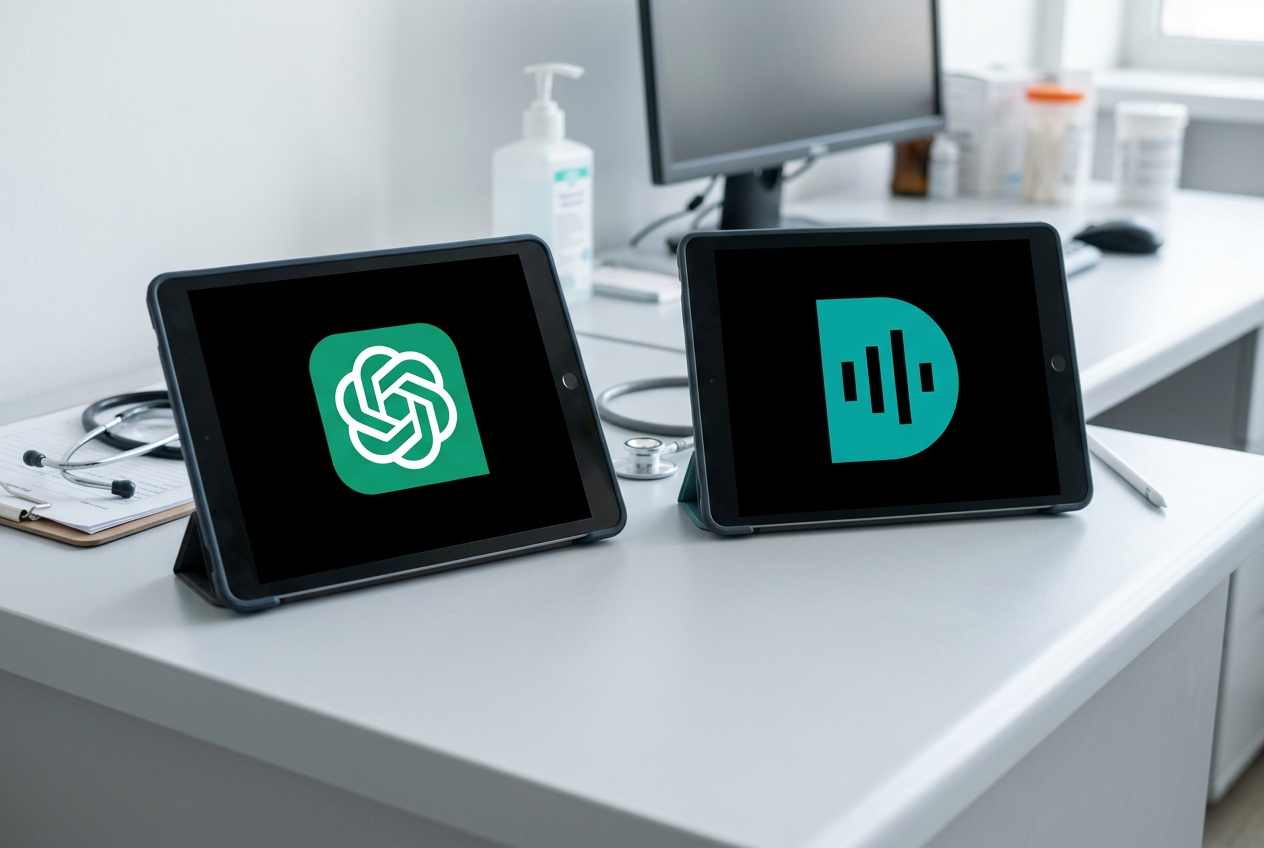
ChatGPT vs an AI medical scribe is a workflow comparison, not simply a contest over which tool writes a better paragraph. A general chat interface can help organize information you provide. A clinical scribe is designed around capturing an encounter and producing documentation for clinician review. Whether either option belongs in your practice depends on the exact deployment, its safeguards, and the work needed to produce an accurate final note.
The practical question is how information moves from the consultation into the medical record. Compare the entire process, including capture, corrections, patient context, approval, and transfer into your electronic medical record (EMR).
This article is published by Dorascribe, an AI clinical documentation provider. It compares workflow categories rather than reporting a hands-on product benchmark. Product capabilities and contractual terms should be checked for the specific plan and configuration under consideration. Guidance reviewed October 14, 2026.
In this article
- What you are actually comparing
- Compare the complete documentation workflow
- Privacy depends on the deployment
- A fictional documentation example
- How to choose for your clinic
What you are actually comparing
Three different arrangements are often grouped under the label ChatGPT. Keeping them separate makes the comparison more useful.

A personal chat interface
A clinician might type a fictional case into a personal chat interface and ask for a SOAP note. This can be useful for learning how a structure works or comparing writing styles. It does not, by itself, establish an approved workflow for identifiable patient information.
The clinician supplies the source material, decides what the instructions should say, checks the result, and determines where the output goes. If the clinician reconstructs the encounter from memory, the quality of that reconstruction becomes part of the documentation risk.
An organization-approved deployment
An institution may approve an AI workspace for particular tasks under specified contracts, permissions, and retention rules. That approval should identify which information may be used, which features are allowed, and who is accountable for the result. A paid subscription alone does not answer those questions.
OpenAI’s official workspace guidance explains that HIPAA and Business Associate Agreement coverage depend on the features and agreement in use. It also distinguishes connected services, which have their own access and data-handling requirements. Those boundaries matter when a workflow adds a recorder, file uploader, or third-party application.
A purpose-built clinical scribe
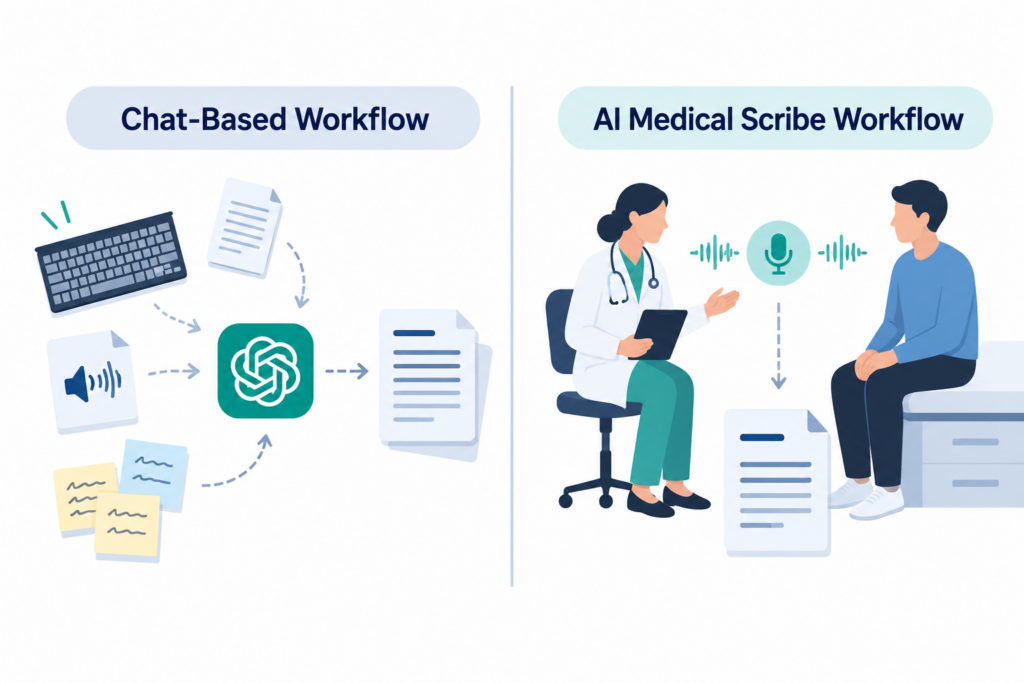
An AI medical scribe typically brings encounter capture, a documentation structure, and review into a clinical workflow. The implementation varies by vendor. Some products work alongside an EMR; others have a supported integration or a browser extension.
A purpose-built interface can reduce the number of steps clinicians must assemble themselves. It does not guarantee that every draft is correct, that every EMR is supported, or that every use is approved by the clinic.
Compare the complete documentation workflow
Use the following questions to compare a chat-based workflow with a clinical scribe. The table describes what to verify, rather than assigning unsupported feature ratings.
| Documentation task | Chat based workflow | Clinical scribe workflow |
|---|---|---|
| Encounter capture | Identify how the source reaches the chat and who checks it | Verify the supported recording method, speaker capture, and failure handling |
| Note structure | Define instructions and keep them consistent | Check available formats and custom-template controls |
| Missing context | Supply approved context and distinguish it from today’s visit | Verify how added context is attributed and whether the product can access it |
| Clinical review | Compare the draft with the source before filing | Check the review interface and ability to correct the draft |
| EMR transfer | Confirm an approved transfer method | Verify the exact integration or transfer workflow for your EMR |
| Governance | Review the workspace, enabled features, and connected tools | Review the vendor contract, account controls, and subprocessors |
Capture creates work before the prompt
A note-generation prompt cannot recover information that never reached the system. If a workflow requires manual transcription, uploading a recording, or copying notes between applications, include those steps in the evaluation.
An ambient scribe may capture the conversation directly, but hands-on findings and silently reviewed results may still need to be added through an approved process. An empty examination field is not evidence that an examination was normal.
If you are choosing between speaking a summary and recording an encounter, Dorascribe’s dictation versus transcription guide explains the underlying distinction. The appropriate capture method can vary by visit.
Consistent instructions matter
A clinician can ask a chat tool for a structured note, but a single successful prompt is not a repeatable clinic process. Check whether instructions are versioned, whether staff use the same approved format, and whether revisions affect later outputs.
Clinical scribes also need configuration. A long universal template can introduce irrelevant text or increase review time. Dorascribe’s custom note template guide describes a workflow for adapting a base structure or importing an existing clinic template.
A fluent note can still be wrong
Both general-purpose language tools and purpose-built scribes can produce unsupported statements or omit important information. Medical terminology and polished formatting do not establish accuracy.
Review the source of each medication detail, time reference, clinical finding, and decision. Pay particular attention to negation: changing “no history of” to “history of” can reverse the meaning while leaving the sentence grammatically correct.
The Canadian Medical Protective Association guidance on AI scribes emphasizes physician review of AI-generated chart entries. Choosing a specialized product does not remove that responsibility.
Privacy depends on the deployment
Avoid the blanket statements that ChatGPT is always unsuitable for healthcare or that every medical scribe is automatically compliant. Evaluate the exact service, contract, settings, and data flow.
OpenAI’s API data-controls documentation describes healthcare-addendum arrangements for eligible services and account configurations. It also states that API data is not used for model training by default unless the customer opts in. Retention rules depend on the endpoint and configuration. These API arrangements should not be assumed to apply to a personal ChatGPT account or to every connected service.
For either workflow, ask your privacy or compliance lead to review:
- What information enters each application, and who can access it.
- Where audio, transcripts, draft notes, and final records are stored and processed.
- Which contracts cover the services and subprocessors involved.
- How retention, export, deletion, and staff offboarding work.
- What patient communication and consent processes apply locally.
Removing a patient’s name does not necessarily make a detailed encounter safe to share. Dates, unusual events, and combinations of clinical details may still identify someone. Use fictional cases for early testing, and obtain the required approval before using patient information.
Dorascribe’s AI transcription security guide provides related vendor-review questions. It should support, rather than replace, the clinic’s own privacy assessment.

A fictional documentation example
Consider this invented source passage. It is a documentation exercise, not a treatment recommendation:
“The patient reports left shoulder discomfort that started three days ago. They have not tried the exercise programme discussed previously. Today’s visit was by telephone, and no physical examination was performed. The clinician plans an in-person assessment before deciding on treatment.”
A faithful draft might state that the symptoms were reported by the patient, that the visit was by telephone, and that examination and treatment decisions remain pending. It should not describe shoulder strength, record an exercise programme as completed, or add a diagnosis that the clinician did not make.
For a chat workflow, first assess whether the supplied passage accurately captures the encounter. Then assess the generated note. For a scribe workflow, check whether the recording and transcript preserve the same details before checking the note. A defect in the source and a defect in the generated note are different problems and may need different fixes.
This example is deliberately short. A real evaluation should also include multiple concerns, interrupted sentences, corrected medication details, and uncertainty about the plan.
How to choose for your clinic
Start with the task you need to complete
An approved chat workflow may suit non-patient administrative writing or work with fictional educational examples. A clinical scribe may be a better operational fit when the recurring task is capturing consultations and producing reviewable encounter notes.
An organization with an approved healthcare AI deployment may make a different choice. Compare that actual deployment, including the tools available and the contracts in place, rather than treating all chat interfaces as identical.
Measure time until the note is ready to file
Include setup, capture, context entry, generation, source checking, corrections, and transfer. A workflow that generates a draft quickly may still require substantial review.
Measure several representative visit types. Keep failed captures and incomplete drafts in the results. Compare the total process with the current workflow, using the same definition of a completed note. Dorascribe’s time-savings guide explains why drafting time and finalization time should be considered separately.
Verify the proposed EMR workflow
Ask for a demonstration using your actual EMR and the intended plan. Native integration, a browser extension, document export, and copy-and-paste are different mechanisms. Check patient matching, formatting, review controls, and what happens when a transfer fails.
An integration logo or a claim of compatibility does not explain which fields can be populated. The AI scribe and EMR integration guide provides background for this discussion.

Where Dorascribe fits
Dorascribe describes a workflow for capturing consultations, generating structured drafts, and editing notes before transfer. Its public materials also describe custom templates and related documents. Evaluate the relevant features against your clinic’s requirements and confirm plan access before adopting them.
You can explore Dorascribe’s clinical documentation workflow or book a demonstration focused on a representative visit. Ask to see the review and transfer stages, not only the first generated draft.
Common questions
Can ChatGPT write a SOAP note
A chat-based tool can organize supplied information into a SOAP format. That establishes a text-generation capability, not approval to process identifiable patient data or evidence that the draft is accurate.
Is an AI medical scribe always more accurate
No universal claim is justified. Compare documented evaluations and run an approved, representative test. The relevant question is whether the complete workflow produces reliable notes with manageable review effort.
Does an approved AI service remove the need for consent and review
No. Vendor safeguards, patient communication, and clinician review address different responsibilities. Follow the requirements of your jurisdiction, institution, and professional regulator.
Which option should a clinician try first
For encounter documentation, begin with the workflows your organization permits. Test them on fictional cases, confirm privacy approval, and compare the time and corrections needed to reach an accurate final note. Do not choose solely on the appearance of a single draft.
This article provides general information about documentation workflows. It is not medical, legal, or compliance advice.