
Quick Summary
- Choosing the best AI medical scribe for a small medical practice requires balancing accuracy, ease of use, privacy, and cost.
- Small practices benefit most from tools that reduce documentation time without adding complexity.
- Transparency, clinician oversight, and patient privacy should be non-negotiable.
- This guide walks through the key criteria small practices should evaluate before adopting an AI medical scribe.
Introduction
For small medical practices, documentation is often one of the biggest operational challenges. Limited staff, tight schedules, and growing administrative requirements leave clinicians spending hours on notes instead of patient care. That’s why many providers are now asking how to choose the best AI medical scribe for a small medical practice—one that improves efficiency without adding technical burden.
AI medical scribes are designed to support clinicians by drafting structured visit notes while preserving face-to-face patient interaction. When implemented correctly, they can significantly reduce burnout and help small practices operate more smoothly, as outlined in Dorascribe’s discussion on eradicating physician burnout.
Why Small Medical Practices Have Unique Needs
Unlike large healthcare systems, small practices don’t have IT teams, compliance departments, or dedicated scribes. That makes choosing the best AI medical scribe for a small medical practice fundamentally different from enterprise-level decision-making.
Small practices typically need:
- Minimal setup and training
- Clear, predictable workflows
- Strong privacy safeguards
- A tool that supports—not disrupts—patient visits
This is why understanding how AI documentation has evolved matters. The evolution of medical scribing shows a clear shift toward lightweight, clinician-controlled tools designed for practices of all sizes.

What “AI Medical Scribe” Actually Means Today
Before selecting the best AI medical scribe for a small medical practice, it’s important to understand what modern AI scribing does—and what it doesn’t.
Most AI medical scribes:
- Capture clinician–patient conversations (often via audio)
- Generate a draft clinical note
- Allow clinicians to review and edit before finalizing
Responsible tools treat AI output as a draft, not a final record. Dorascribe reinforces this approach in its explanation of real-time AI medical scribing, where clinician review remains central to patient safety.

Key Criteria When Choosing the Best AI Medical Scribe for a Small Medical Practice
Accuracy and Clinical Context
Accuracy is non-negotiable. The best AI medical scribe for a small medical practice should understand medical terminology, capture relevant details, and structure notes consistently.
Specialty awareness is also important. For example, Dorascribe shows how AI adapts to clinical nuance in areas like cardiology, as described in AI scribes in cardiology.

Ease of Use for Clinicians
Small practices can’t afford steep learning curves. An effective AI medical scribe should fit naturally into the visit, allowing clinicians to speak normally without changing how they interact with patients.
This usability focus supports stronger communication and trust, which Dorascribe highlights in its overview of improving doctor–patient relationships.

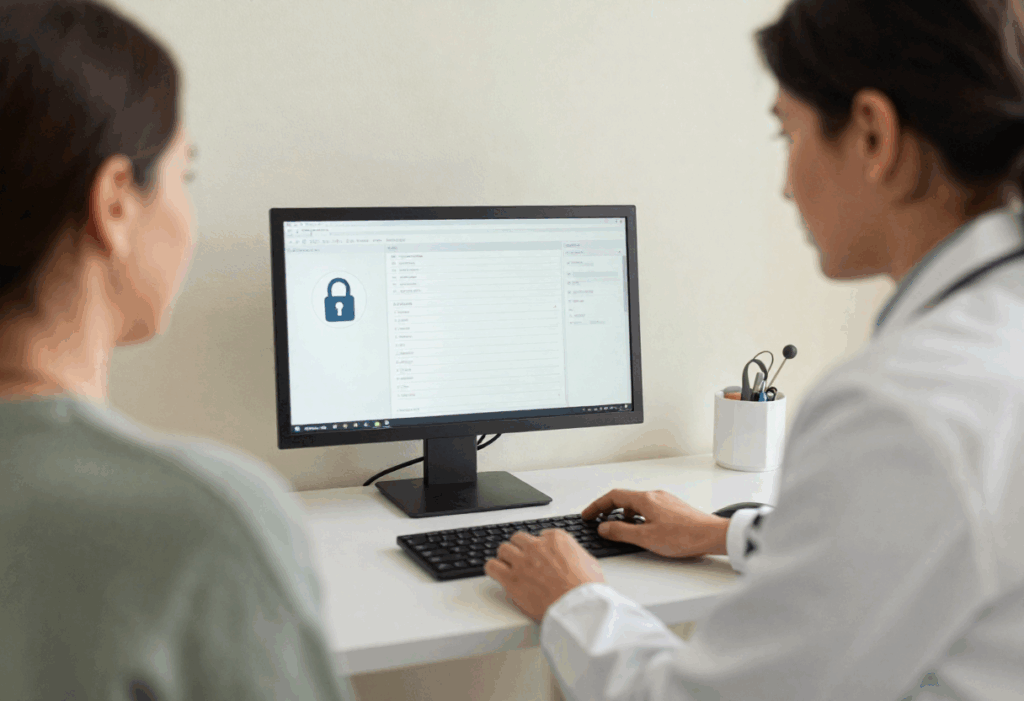
Privacy and Patient Trust
Patient trust is especially important in small practices, where relationships are often long-term and personal. Any AI medical scribe must clearly address:
- Data storage
- Access controls
- Retention policies
Strong privacy safeguards are foundational, as outlined in Dorascribe’s guidance on ensuring patient privacy.
Flexibility Across Visit Types
The best AI medical scribe for a small medical practice should support in-person visits, follow-ups, and virtual care without forcing different tools for different scenarios.
AI documentation plays a growing role in remote care, which is why Dorascribe explores its use in AI medical scribes for telehealth.

Cost Transparency and Scalability
Small practices need predictable costs and the ability to scale gradually. AI medical scribes should offer clear pricing without requiring enterprise-level commitments.
Cost transparency is especially important for small practices that need to manage expenses carefully. The best AI medical scribe for a small medical practice should offer predictable pricing and flexible usage without forcing long-term commitments or enterprise-level complexity. Rather than paying for features designed for large systems, small clinics benefit most from focused functionality that reduces documentation time and improves daily workflows.
Dorascribe addresses this practical approach by emphasizing efficiency and clinician control, which is further explained in its overview of AI medical scribing in 2025 and how modern tools are designed to scale with practice needs instead of overwhelming them.

Questions Small Practices Should Ask Before Choosing
When evaluating the best AI medical scribe for a small medical practice, clinicians should ask:
- Who reviews and approves notes before finalization?
- How is patient consent handled?
- What data is stored, and for how long?
- Who can access documentation?
Small practices should clearly understand how notes are reviewed, how patient consent is handled, and how transparency is maintained during visits. Many of these considerations are also addressed from the clinician’s perspective in Dorascribe’s guide to top questions doctors ask before switching to an AI medical scribe, which helps small practices align internal workflows with patient expectations and regulatory responsibilities..
Common Pitfalls to Avoid
Small practices should be cautious of:
- Tools that promise “fully automated” notes without review
- Unclear privacy or data usage policies
- Complex setups designed for large health systems
Misunderstandings around AI capabilities are common, which is why Dorascribe addresses them directly in AI medical scribing myths debunked.
FAQ: Choosing the Best AI Medical Scribe for a Small Medical Practice
What makes an AI medical scribe suitable for a small practice?
Simplicity, accuracy, clinician control, and strong privacy safeguards are more important than advanced enterprise features.
Do AI medical scribes replace human judgment?
No. The best AI medical scribe for a small medical practice supports clinicians by drafting notes, but clinicians remain fully responsible for review and approval.
Is AI medical scribing only for large clinics?
No. Modern tools are designed to work well for solo practitioners and small teams.
How long does it take to see benefits?
Many practices report reduced documentation time within weeks, especially when workflows are clearly defined.

Final Thoughts: Making the Right Choice
Choosing the best AI medical scribe for a small medical practice isn’t about adopting the most advanced technology—it’s about finding a tool that fits your workflow, protects patient trust, and gives clinicians time back.
Dorascribe was built with these principles in mind, focusing on clinician control, patient privacy, and practical workflows for practices of all sizes.
To explore how Dorascribe approaches AI medical scribing:
- Visit the Dorascribe FAQs for common questions
- Learn how the platform supports responsible documentation in ensuring patient privacy
- Discover how real-time drafting improves clinical focus in real-time AI medical scribing