
Quick Summary
Even high-performing practices lose 6 or more hours every week to inefficient processes that could be streamlined. From manual documentation and repetitive data entry to after-hours charting and intake bottlenecks, the real issue isn’t effort — it’s lack of structured healthcare workflow automation.
This article breaks down exactly where clinics are still losing time, why it happens, and how modern workflow optimization tools — including AI-powered documentation — can recover hours without adding staff.
The Real Cost of Inefficient Healthcare Workflow Automation
When practitioners think about automation, they often imagine large-scale IT transformations. But in reality, most time loss happens in small, repetitive workflow gaps:
- Manually typing visit notes
- Re-entering patient information across systems
- Clarifying incomplete documentation
- Staying late to finish charts
- Back-and-forth communication with staff
Individually, these tasks seem manageable. Collectively, they drain 6+ hours per provider per week — sometimes more.
This is where strategic healthcare workflow automation changes the equation. Instead of focusing only on scheduling or billing, modern systems streamline documentation, communication, and data capture at the point of care.
For example, tools that generate structured notes during the visit reduce the need for after-hours charting — something explored in depth in Do AI Scribes Save Time?.

Where Clinics Lose the Most Time (And Don’t Realize It)
1. Documentation Bottlenecks
Manual note-taking remains the largest time drain in outpatient care. Even efficient typists lose minutes per encounter — multiplied across 20+ patients daily.
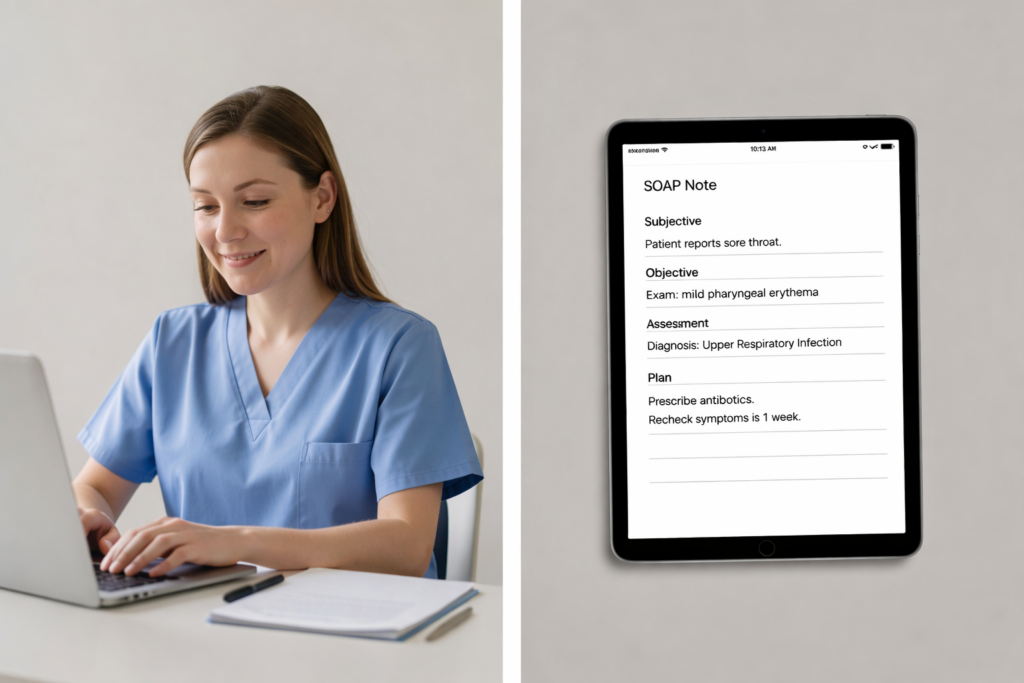
Modern healthcare workflow automation integrates AI-generated documentation into clinical workflows. Instead of typing, clinicians review structured drafts created in real time.
You can see how this works in practice in AI Generated Doctors Notes, where structured documentation is produced during the patient interaction rather than after it.

2. After-Hours “Pajama Time”
One of the clearest indicators of poor workflow optimization is documentation spilling into evenings and weekends.
Automation at the point of care — particularly through solutions like Real-Time AI Medical Scribe — reduces the need for post-visit charting by drafting notes during the consultation.
When properly implemented, healthcare workflow automation shifts documentation from reactive to concurrent.

3. Repetitive Data Entry Across Systems
Many clinics still duplicate information across EHRs, billing systems, and communication tools.
True workflow optimization connects documentation to downstream processes:
- Structured notes reduce billing clarification
- Accurate documentation reduces compliance reviews
- Standardized outputs reduce internal corrections
This is why selecting the right system matters — especially for smaller practices. In Best AI Medical Scribe for Small Practice, we outline what features actually improve operational efficiency.
4. Communication Gaps Between Staff
Workflow inefficiencies don’t stop at documentation. When notes lack structure or clarity, staff spend time clarifying follow-ups, referrals, or medication changes.
Healthcare workflow automation helps standardize documentation formats, reducing ambiguity and back-and-forth messaging.
This becomes especially critical in specialties like behavioral health, where structured narrative capture is essential. The workflow improvements in AI Scribe Psychiatry show how automation supports more nuanced documentation without adding administrative load.

Healthcare Workflow Automation and Patient Trust
Efficiency should never come at the expense of transparency. Patients are increasingly aware of AI in healthcare settings.
Clinics implementing workflow automation tools must ensure clear communication and data security.
Patients often ask:
- Is the visit being recorded?
- How is my data protected?
- Who reviews the notes?
We address those concerns in Questions to Ask Your Doctor About AI Recording, which outlines transparency best practices for modern documentation workflows.
Security is equally critical. If workflow automation relies on AI transcription, privacy safeguards must be clearly defined. In Is AI Transcription Safe?, we explain how secure infrastructure protects patient data while supporting efficiency.

The 6+ Hours Per Week Breakdown
Here’s a conservative estimate of weekly time loss in clinics without optimized workflow automation:
| Task | Time Lost Per Week |
| Manual charting | 2–3 hours |
| After-hours note completion | 1–2 hours |
| Documentation corrections | 30–60 minutes |
| Staff clarification | 30–60 minutes |
| Duplicate data entry | 1 hour |
Total: 6+ hours per provider per week
Multiply that across multiple clinicians, and the operational impact becomes significant.
Healthcare workflow automation isn’t about replacing clinicians — it’s about removing friction.
Why Some Clinics Still Resist Automation
Despite clear benefits, adoption hesitations remain. Common concerns include:
- Accuracy of AI-generated notes
- Privacy and compliance
- Workflow disruption
- Integration complexity
However, modern platforms address these concerns through:
- Real-time clinician review
- Structured documentation formats
- Secure, encrypted processing
- Seamless EHR compatibility
Importantly, automation should enhance — not replace — clinical judgment.

Beyond Documentation: The Next Phase of Healthcare Workflow Automation
Most clinics begin with documentation automation, but the long-term vision extends further:
- Automated intake summaries
- Structured follow-up instructions
- Smart referral documentation
- Quality assurance review triggers
- Audit-ready compliance formatting
When documentation is standardized at the source, downstream processes become smoother.
This is the core principle behind healthcare workflow automation: reduce variability, reduce redundancy, and reduce after-hours administrative burden.

What an Optimized Workflow Looks Like
In a streamlined clinic:
- The patient encounter is captured securely.
- A structured draft note is generated.
- The clinician reviews and edits in real time.
- The finalized note enters the record immediately.
- Staff receive clear, standardized follow-up instructions.
This is the operational shift that saves those 6+ hours weekly.

Measuring the Impact of Healthcare Workflow Automation
Clinics that implement workflow automation typically track improvements in:
- Time to chart completion
- After-hours documentation reduction
- Patient throughput
- Documentation accuracy
- Staff communication efficiency
The goal isn’t just speed — it’s reliability and consistency.
Final Thoughts: The Time Is Already Being Spent
Most clinics don’t realize they’re losing 6+ hours weekly because the time is fragmented across small tasks.
But fragmentation doesn’t make it insignificant.
Strategic healthcare workflow automation eliminates repetitive work at its source. When documentation becomes concurrent, secure, and structured, operational pressure decreases.
If you’re evaluating automation tools, start by understanding how real-time documentation works in practice through Real-Time AI Medical Scribe and explore structured note generation in AI Generated Doctors Notes.
For practices considering adoption, the small-practice guide at Best AI Medical Scribe for Small Practice provides a practical decision framework.
And if your primary concern is data protection, review Is AI Transcription Safe? to understand the security standards behind modern documentation systems.
Recovering 6+ hours per week isn’t about working faster.
It’s about building workflows that work for you.