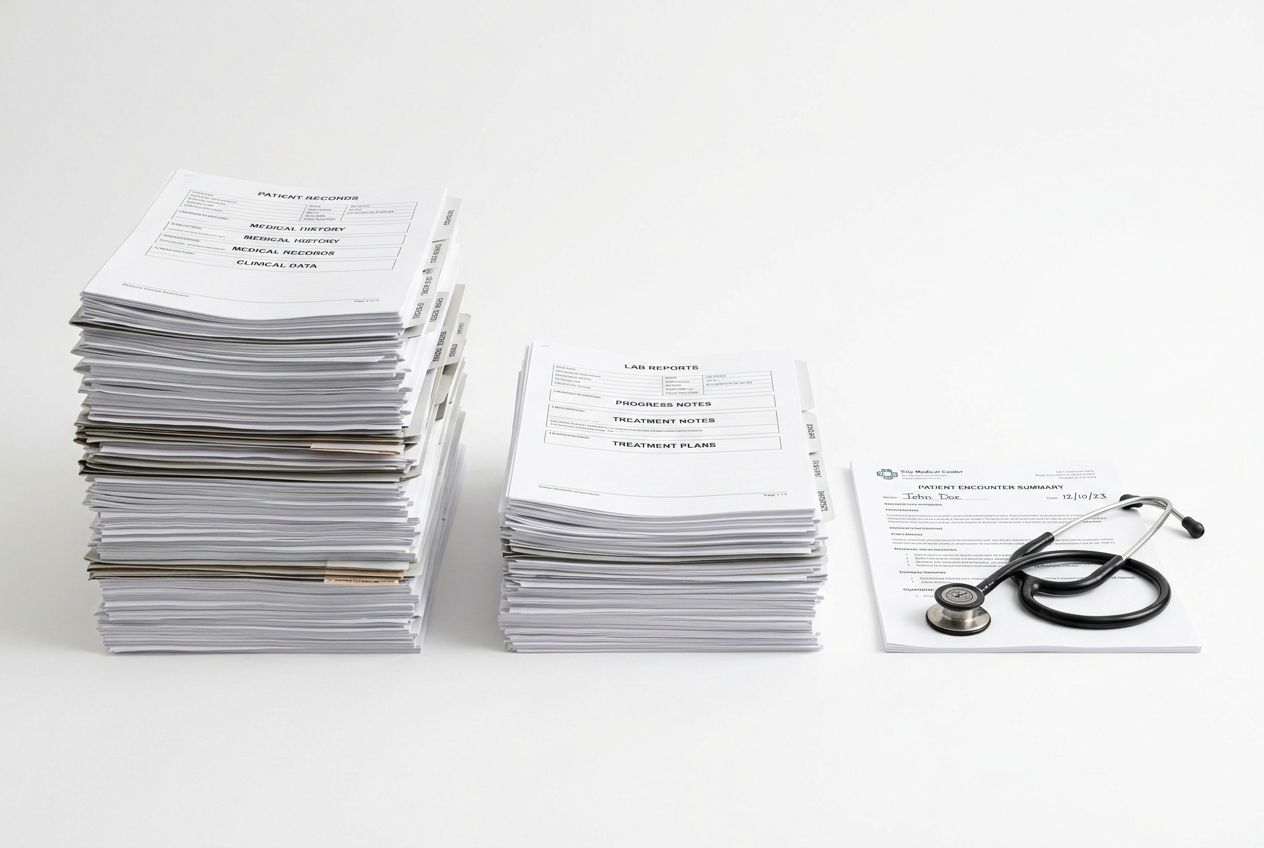
Quick answer: Prevent AI-generated note bloat by defining the purpose of each note type, limiting templates to clinically useful sections, distinguishing current findings from imported history, prohibiting unsupported default text, and measuring repeated deletions and corrections after launch. The goal is not the shortest possible note. It is a concise, accurate record in which the current assessment, reasoning, plan, and follow-up are easy to find.
Clinical documentation becomes bloated when repeated, outdated, low-value, or weakly supported content makes the important information harder to find. The problem predates generative AI. Copy-paste, macros, imported data, and overbuilt templates can all lengthen a chart. AI can reduce manual drafting, but it can also reproduce these patterns at greater speed when the workflow rewards completeness by volume rather than usefulness.
A fluent note is not automatically a good note. The draft must still represent the current encounter, separate observation from history, preserve uncertainty, and support the next person who relies on the chart. AHRQ describes meaningful, accurate, and complete documentation as important to diagnostic safety, while federal guidance has warned that long, repetitive notes can make relevant information more difficult to locate.
What note bloat looks like in practice
Length alone is an imperfect measure. A complex consultation may appropriately require more detail than a routine follow-up. Bloat is better identified by low-value repetition and poor information hierarchy. A note may be bloated when the same history appears in several sections, prior findings are carried forward without verification, normal findings are populated without support, long data lists obscure interpretation, or the plan is difficult to distinguish from background narrative.
Other signals include clinicians deleting the same paragraphs in every draft, copied information that conflicts with the current encounter, template headings that rarely contain useful content, and patient statements repeated verbatim when a concise clinical summary would be more useful. The issue is not aesthetic. Excess text can increase review time, cognitive load, correction work, and the chance that a material change is overlooked.

Edit for the next reader, not only the current author
A note is read by people who were not in the room: covering clinicians, specialists, nurses, pharmacists, coders, quality reviewers, and sometimes patients. Ask representative readers to find the current problem, material change, assessment, plan, and unresolved follow-up in a sample note. If they must search through repeated history or imported lists, the structure needs work even when every sentence is technically readable.
Reader testing can reveal problems that the author no longer notices because the template is familiar. Use short, task-based questions rather than asking whether a note looks good. For example: What changed today? Which information was reported rather than observed? What action must happen next? Where is uncertainty documented? The answers should be available without reconstructing the encounter from several sections.
Why AI systems can amplify an old documentation problem
An AI scribe responds to the instructions, templates, context, and product settings it is given. If the template requests every possible section, the draft may try to fill them. If the system receives large amounts of chart history without a clear rule for relevance, old information may dominate the current story. If users equate detail with quality, they may accept repetitive output until it becomes the new normal.
This is why implementation should begin with the clinic’s medical dictation workflow rather than with prompt wording alone. Map what information is created, imported, transformed, reviewed, and signed. Decide which system is the source of truth and which facts should be referenced rather than repeated in narrative text.

Seven controls that keep AI-generated notes useful
Define the job of each note type
Write a one-sentence purpose for each governed note type. A follow-up note may need to show what changed, how the patient responded, the current assessment, and the next plan. A procedure note has different requirements. A referral letter serves another reader and should not simply reproduce the entire progress note. A clear purpose makes it easier to decide what belongs and what does not.
Reduce template surface area
Review every heading and field. Keep sections that support clinical care, communication, applicable documentation requirements, or an operational need. Remove decorative structure that creates empty headings or invites generic filler. DoraScribe’s overview of doctor’s note templates and guide to custom AI scribe templates can help teams redesign the structure around real encounters.
Separate current, historical, and imported information
A reader should be able to tell what the patient or clinician reported today, what was observed today, what came from a prior record, and what remains uncertain. Configure templates and review practices so older information is not presented as a new finding. When a stable data element already exists elsewhere in the EHR, consider referencing or displaying it appropriately instead of reproducing it in every narrative section.
Do not generate unsupported normal findings
Empty template sections should remain empty or be removed according to policy; they should not be completed with plausible normal language merely to make the note look comprehensive. The clinician should confirm examination findings, procedures, diagnoses, and plans that materially affect the record. CMS documentation-integrity guidance has highlighted the risks associated with auto-filled and copied content that creates unintended errors.
Summarize conversation instead of transcribing everything
Clinical notes are not always verbatim transcripts. Long conversational passages may include repetition, false starts, unrelated detail, and statements from multiple speakers. The draft should preserve clinically material facts, uncertainty, and relevant patient language without converting the entire encounter into narrative. Clinics should define when a direct quotation is useful and when a concise attribution is clearer.
Make the assessment and plan visually easy to find
Important current information should not be buried beneath imported lists and repeated history. Use a consistent heading order and keep assessment, reasoning, plan, follow-up, and unresolved items distinct. For structured workflows, the article on automated SOAP notes provides additional context on where automation helps and where clinician review remains essential.
Treat clinician edits as product and workflow feedback
Repeated deletions are data. If clinicians remove the same review-of-systems paragraph, shorten the same history, or correct the same imported finding, group those edits by template and visit type. Assign an owner and change the configuration rather than asking every clinician to perform the same cleanup indefinitely. Human oversight remains central, as discussed in why doctors are not being replaced.

A simple before-and-after editing test
Select a representative sample of de-identified or appropriately governed notes from one visit type. Ask clinicians to mark text that is essential, useful but optional, repeated, outdated, unsupported, or better located elsewhere in the chart. Use those patterns to revise the template and generation instructions, then test the same visit type again. The exercise evaluates the documentation system, not individual writing style.
Do not remove content solely to hit a word count. Confirm that the revised note still supports care continuity, referrals, patient communication, coding and billing workflows where applicable, and the clinic’s legal and professional obligations. A qualified clinical and compliance reviewer should approve the governed template before broader release.
Measure usefulness, not just note length
Median word count can reveal drift, but it should be paired with stronger measures: clinician editing time, repeated deletion rate, missing material information, unsupported statement rate, time to locate the current assessment and plan, corrections after signature, and reader-reported usefulness. Track results by specialty, visit type, template version, and major configuration change.
Establish a baseline before changing the template. Review a consistent sample size at a defined cadence, and document who applies the criteria. When a new model, prompt, EHR field mapping, or template version is released, increase sampling temporarily and compare the results with the prior version. Without version information, teams may see note quality change without knowing which configuration introduced it.
Efficiency should not be defined as generating more text. DoraScribe’s practical tips for saving time on medical charting can complement template redesign, while the clinic’s quality measures confirm that reduced editing has not created new omissions or ambiguity.
Prevent duplicate narrative when connecting to the EHR
Integration can reduce manual transfer, but it can also duplicate content when the same information lands in several chart locations. Review DoraScribe’s EHR and EMR integration options and map where each data element should live. Define whether the scribe creates a draft note, populates specific fields, or returns another structured output, and prevent an unreviewed version from coexisting with the signed source of truth.

Concise documentation is a governance practice
Note bloat is not solved by one prompt. It requires governed templates, relevant context, clear authorship, clinician review, version control, and monitoring after launch. The best output is not the note with the fewest words. It is the note that makes the current clinical story and next action clear without carrying unnecessary text forward.
Set a recurring review date and a change owner for every production template. Retire unused versions, keep a record of why material sections changed, and communicate updates to clinicians before release. A concise template can become bloated again when new fields are added one request at a time without removing outdated requirements or testing the combined result.
Clinics can compare the features that matter in medical scribe software and then book a DoraScribe template demonstration using one of their real note structures and a defined quality-review process.
Sources and further reading
AHRQ: Challenges and Opportunities for Improvement in Diagnostic Documentation. Official issue brief discussing meaningful, accurate and complete health records, documentation structure, diagnostic communication, cognitive load, and correction practices.
AHRQ: Measuring Documentation Burden in Healthcare. Technical-brief program describing quantitative and qualitative approaches to documentation burden across settings and clinician populations.
CMS: Documentation Integrity in Electronic Health Records. Official fact sheet describing documentation-integrity risks associated with copy functionality, templates, macros, auto-fill, authorship, and audit controls.
ASTP/ONC and CMS: Strategy on Reducing Regulatory and Administrative Burden. Federal strategy discussing excessive documentation, note bloat, copy-paste, usability, and the burden of locating important information in repetitive notes.